New Zealand Journal Entries, September-October 2026
Auckland, New Zealand, Sunday September 13, 2026, first full day in New Zealand.
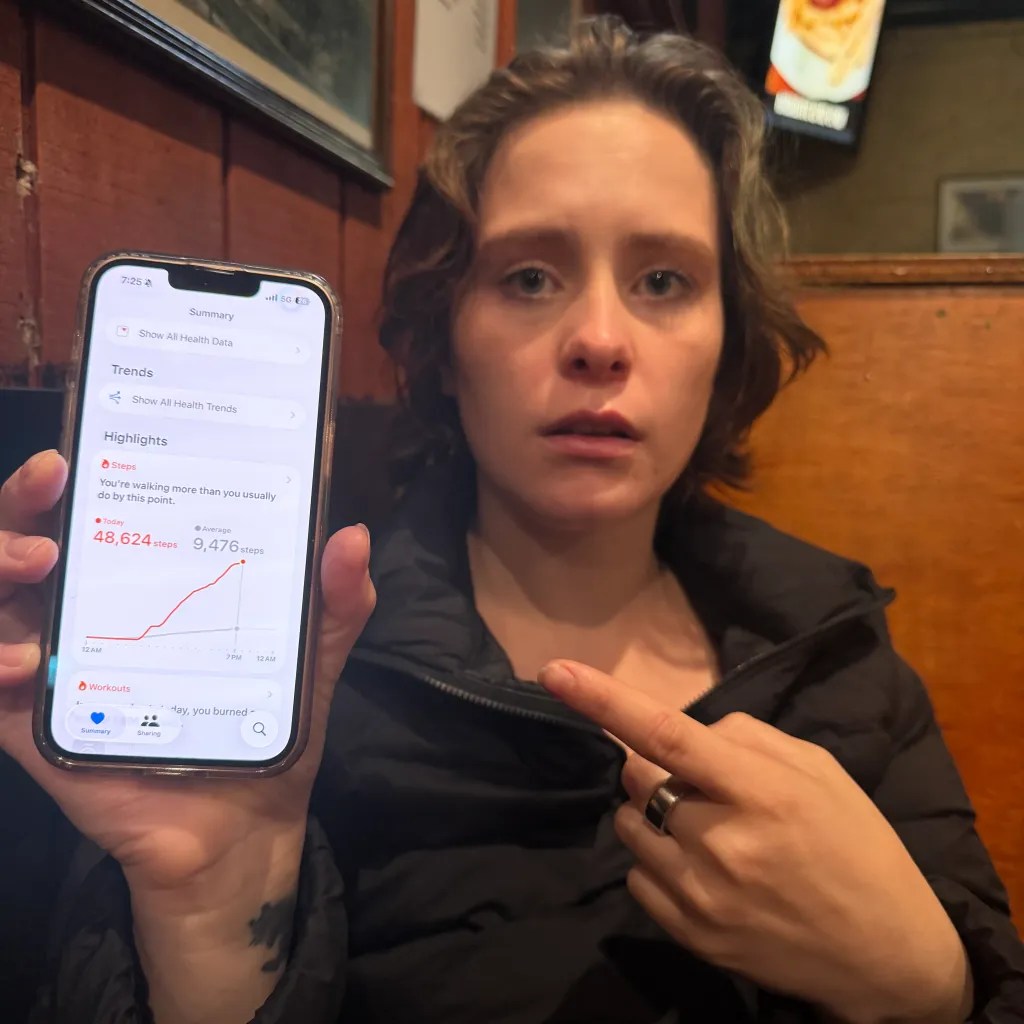
My legs hurt. Catie and I walked 47,000 steps (22 miles, 35.4 kilometers) today. Yesterday was a little rough. We flew from Seattle to Los Angeles and the flight attendant sang happy birthday to a seven year old on board over the intercom like she had just taken off her frock and walked out of church with her vocal chords still warm. People cheered. Catie swore up and down to my parents that she loved LAX, but as we waited for our shuttle bus at Gate C67 after asking a kindly old man in a yellow vest for directions she admitted that she had only ever flown domestic and that she was having a terrible time. It’s alright. You’re supposed to have a terrible time at LAX. It’s a horrible place. The flight to Fiji went as smoothly as it’s ever gone for me, but poor Catie caught cold and sniffed and snuffled for all ten hours next to a fat old woman who looked dead the whole time.
In Fiji we met a lovely Kiwi in his 60’s who told us that he had been trying to fly out of London right when Andy Burnham announced that the UK would be sanctioning Israel for their genocide of Palestinians and Heathrow airport was shut down because of a bomb threat or a terrorist attack or whatever. Global politics are hard to keep up with. 600 flights canceled. He had been flown to Dublin, then to Vancouver, where he missed his connecting flight, then to Fiji. He told us that he had been in transit for more than 48 hours and that the last eight of his flights had been late. We sympathized with him, then the airport staff announced that our flight’s departure time was being delayed by two hours. The gentleman ambled away. Good riddance – he was clearly cursed.
We touched down in Auckland at some point and rode a bus then a train then walked up the main avenue to our hostel. As far as I can tell the central business districts of major commonwealth cities all look the damn same. You get your Pradas and your Givenchys and your Arcteryxs and your “new york style pizza” for 12 bucks a slice and you smell bullshit and try to hustle out of there as quick as possible. Unfortunately our hostel is only a block off the main drag, so we’re stuck walking up and down it all day.
This is my first hostel and Catie says it’s not a good one. As far as we can tell most of the hostel’s denizens just sort of hang around the building all day. I’m sitting in the living room right now and I’m not seeing many people come or go, they’re all just sort of milling around looking at phones and laptops and such. Can’t say I’m any better. I brought a physical journal with me – in fact, I even discarded a journal I was gifted and purchased a slightly different one (the gifted journal was lined, its replacement unlined) – but I can type so fast and I feel too lazy to sit down and writing all this out longhand.
Catie got yelled at by a German girl this morning. She’s terribly sick and the German girl was mad that Catie spent all night coughing. Can’t blame either of them. Catie certainly doesn’t want to cough, and I imagine the German girl isn’t the kind of pervert that intentionally seeks out rhinovirus for the thrill of it. All the same, Frau Bunkmate didn’t have to go around calling Catie a cunt to the 12 other people in the room. Catie may not speak German or French, but it’s not exactly rocket science to decode that one. The vibes in this hostel are weird, I think.
Luckily for Catie, and she is happy about this, we will be terminating our stay here after two nights instead of three and thus wasting $30 USD. This is because last night at the late hour of 7 pm we spent $32 NZD on one beer, one 1 oz. Shot of rum, and one soda water in a crowded bar playing the big rugby game. Jet lagged and tired and panicking, we determined that we may not be able to travel new zealand for less than $4200 USD, which simply will not fly. Everyone we’ve talked to in this hostel so far is here to work. They’re here to be kiwi pickers and engineers and such, and I get the sense that none of them are backpacking the way Catie and I are. The world is changing. Young people don’t make much money and everything seems to cost more than it ever has before. The fellow sitting opposite me is in his 30s and has a genuine Hitler stache. I reckon he’s Argentinian, or Columbian, or from somewhere else in South America, and his mustache is maybe two inches across. It’s crazy. My vision is fuzzy because my contact lenses are filled with fog, so I can’t quite tell if he’s wearing a black beanie or if his hair is just very beanie-like, but I’m leaning towards the sans-beanie option.
Anyhow, we’re skipping a day at this hostel and wasting $30 USD because we’ve determined that the only way we can possibly travel New Zealand while staying on budget is by renting a van. We can get a train from Auckland to Wellington for $300 USD or so, take a ferry to Picton on the south island, bus to Christchurch, and then pick up a campervan for only around $700 NZD to use for the next 21 days. It will serve as transportation and accomodation, and after gas and ferries and our hostels for the next two nights and everything we should have $40 to spend on food and tourist-y things between us per day without breaking our budget. Doesn’t sound so bad, and I’m hopeful we’ll meet more people who are doing it like us and not just germans and french folks on work holiday in the far corner of the world. Does he know he has the same mustache as the 20th century’s greatest dictator? He must, right?
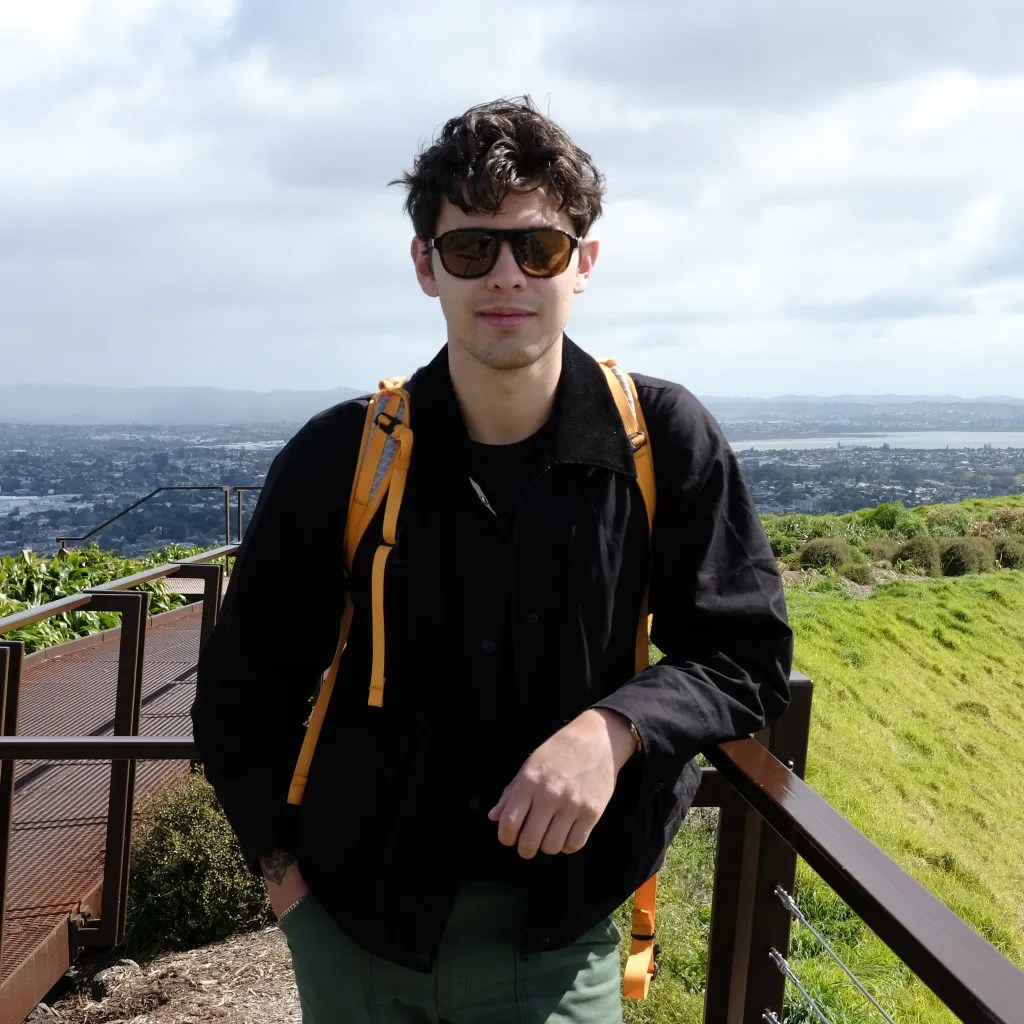
We spent our morning sitting in a cafe planning all this out and renting the van and buying the train and ferry tickets and so on and so forth. By half past noon we had done 26,000 steps and were halfway up Mount Eden, an old Maori hilltop village with a sacred pit in the middle. That was the highlight of the day, I think, and I got a real kick out of seeing the terraces and holes they kept food in. We enjoyed a meat pie ($5 NZD) and some McDonalds ($18 NZD) and we saw the college and the outside of the botanical gardens and the outside of the war museum and a whole bunch of parks and walking paths and a few neighborhoods besides. Lotta french folks in the hostel. Silly accents. Lotta phone calls. I think it’s still rude to make a phone call in a public area even if I can’t understand what it’s about, but hey man I guess we’ve all got different standards for what’s appropriate and what isn’t, and it would be a little weird if the common area was dead quiet anyhow.
I do wonder if it’s my fault that I’m not impressed by this hostel. I’ve been polite, but I haven’t exactly been friendly or outgoing. There’s a guy in sandals and cargo pants and a hoodie who plopped down beside me ten minutes ago and I haven’t even acknowledged his presence. He just adjusted his nuts. Now I can’t acknowledge his presence. What if he’s a lefty? I don’t want to shake the nut-hand.
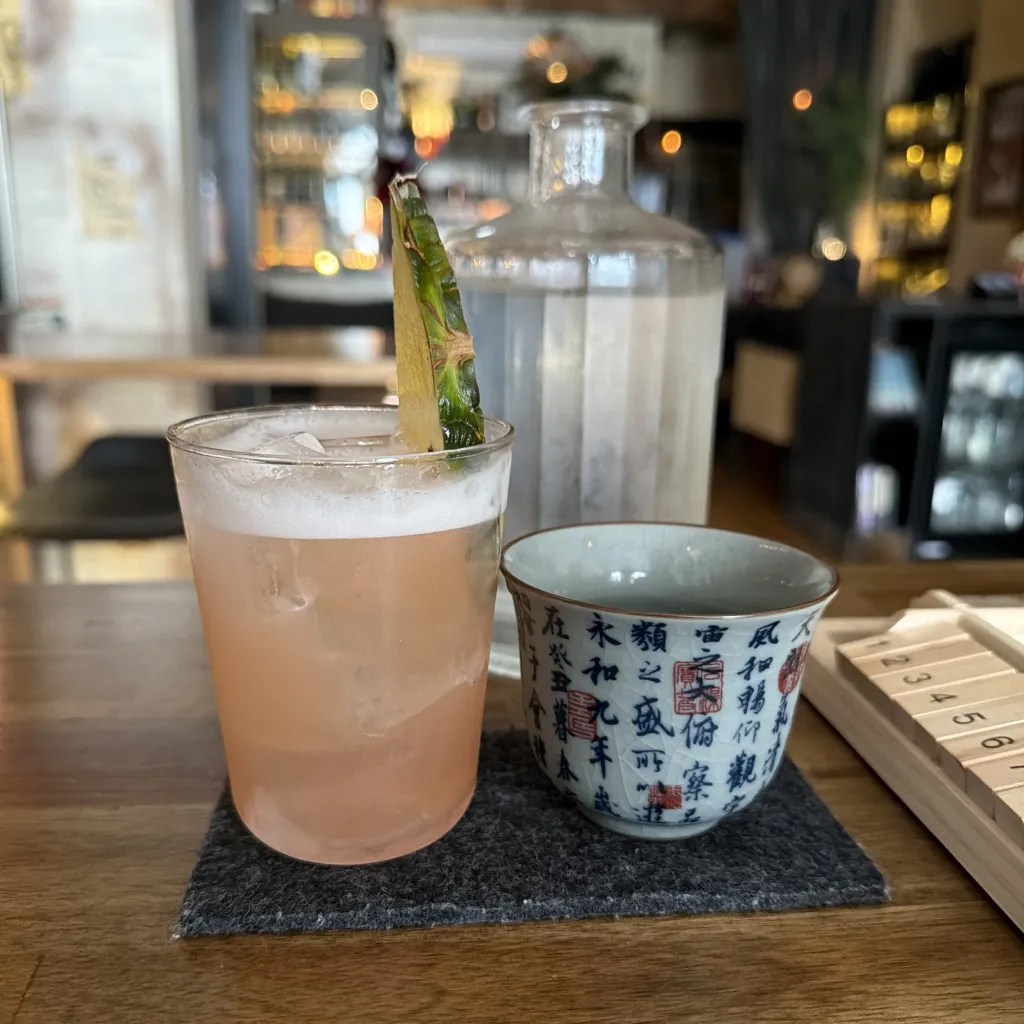
We went to a cocktail bar. Catie is a trooper and a legend. She’s on antibiotics and will be for three days and she still humored me. Caretaker has a funny and kind of annoying gimmick: there’s no menu, you just tell the server what you do and don’t like and then he comes back with a classic cocktail for you. We were pretty worried when the gentleman told Catie that they didn’t have any nonalcoholic spirits, but holy shit did those drinks impress us. They do all their ice in house with molds instead of a machine and juice all their citrus fresh every single day, sometimes multiple times a night. They made me an el presidente with Puerto Rican rum and agricole, and even more excitingly they made Catie a Gordon’s Cup riff with fresh squeezed pineapple juice and pomegranate instead of gin. It was astonishing, and I left thoroughly satisfied. We walked to an Irish pub near the hostel that was advertising $20 spice bags on a big sign and some kiwi guy in his 60s and an Irish fiddler in her 30s were playing a Miley Cyrus/Irish jig medley to an audience of about four alcoholics. It was incredible. They should be playing Madison Square Garden. Two days in and traveling is terrible and also a real blast. I think I’ll shower and then go to bed and hope I wake up before my 5:50 alarm in order to avoid waking up and thus angering Frau Bunkmate.
Tomorrow we’re off on what some guy in Britain considers one of his five favorite train rides in the whole world. It will take 10 hours and we’ll see almost every biome the north island has to offer and I’ll be sure to take plenty of photos for my lovely grandmother who kindly paid for the tickets for my birthday. It takes a village, and I’m excited to visit some of them.
Lake Alexandrina New Zealand, Friday September 18th, 8:58 am.
One week in and backpacking has not been what I expected. To be fair, I didn’t have many expectations at all. I came in blind with no plan and so far I don’t regret it. I guess I thought travel would involve a lot more downtime. It has, in a way. There have been hours on buses and trains and ferries during which there is nothing to do but wait and occasionally look out the window. New Zealand is almost too pretty, by which I mean that sometimes you find yourself thinking “alright, I’ve had enough rolling hills and craggy mountains for a while, let’s see some strip malls now please.”
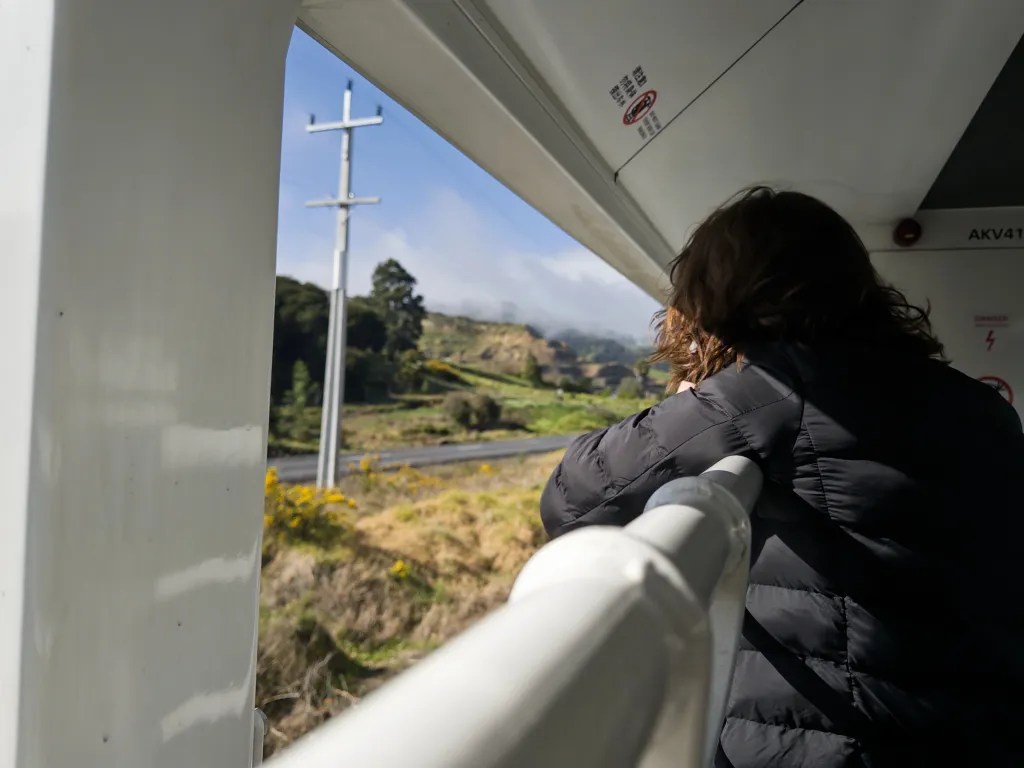
We’re in the van now. On Monday at sunrise we went to Auckland Strand, a bare bones no-nonsense train station staffed by a couple of very chatty train attendants (they can’t all be called conductors, right?). The ride to Wellington took 11 hours and was pretty comfortable for the first seven or eight, though by the end I found myself wishing we would stop slowing down on the scenic bridges and would instead push full speed ahead so I could have dinner and go to bed.
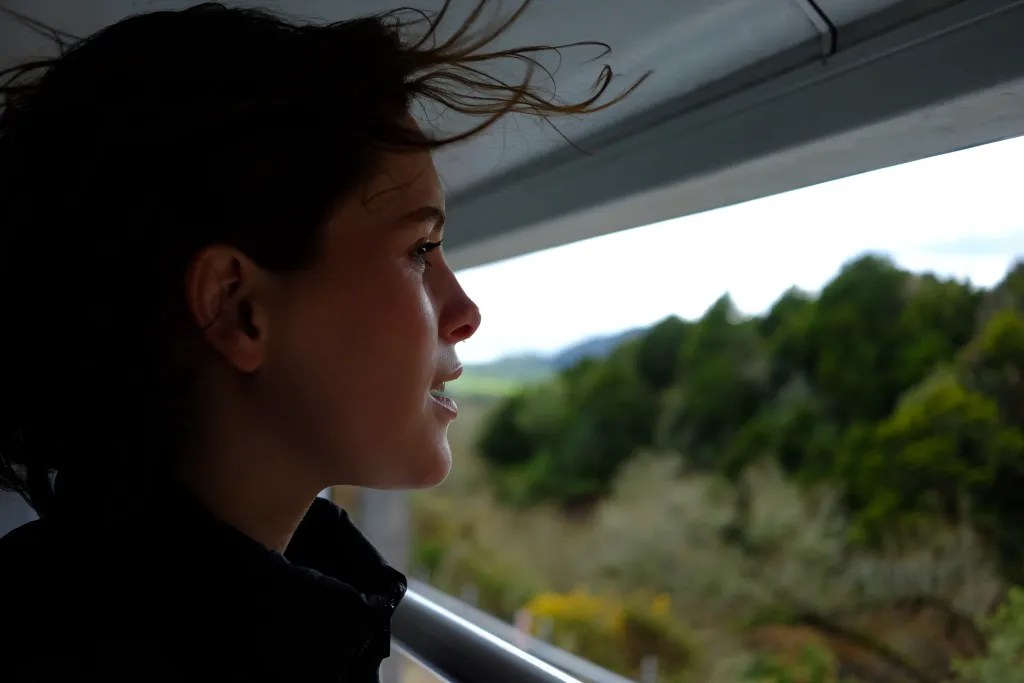
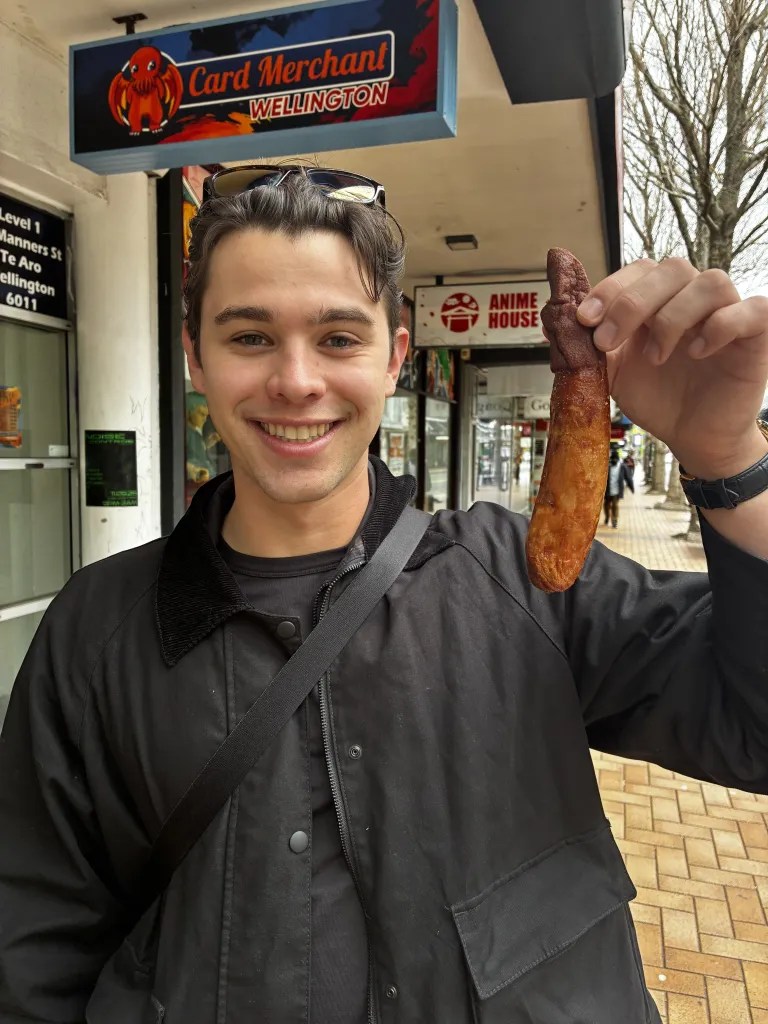
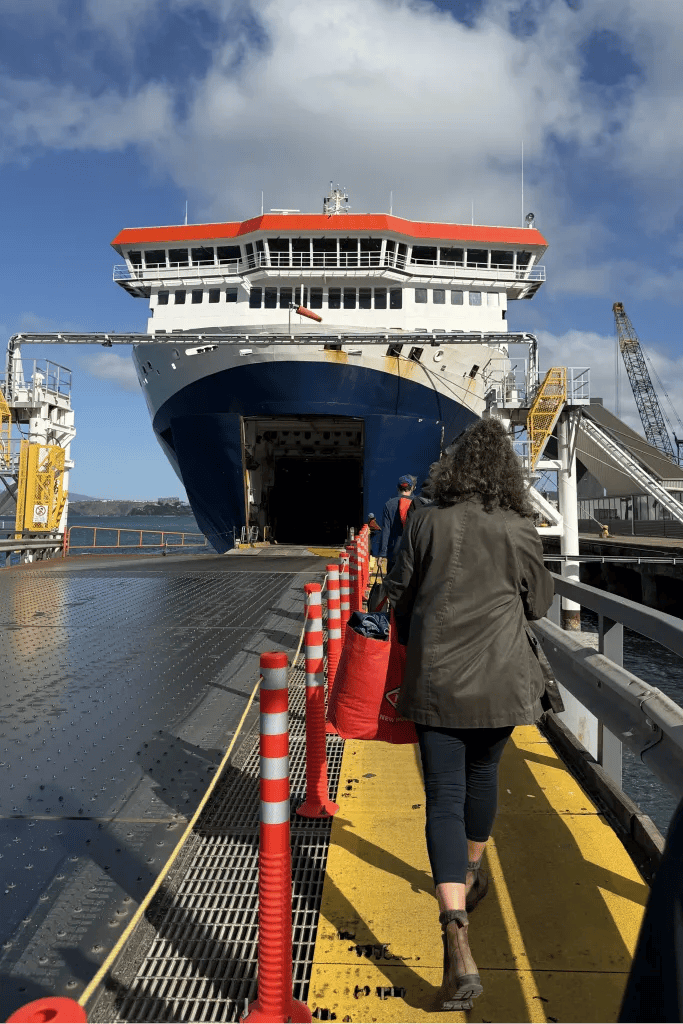
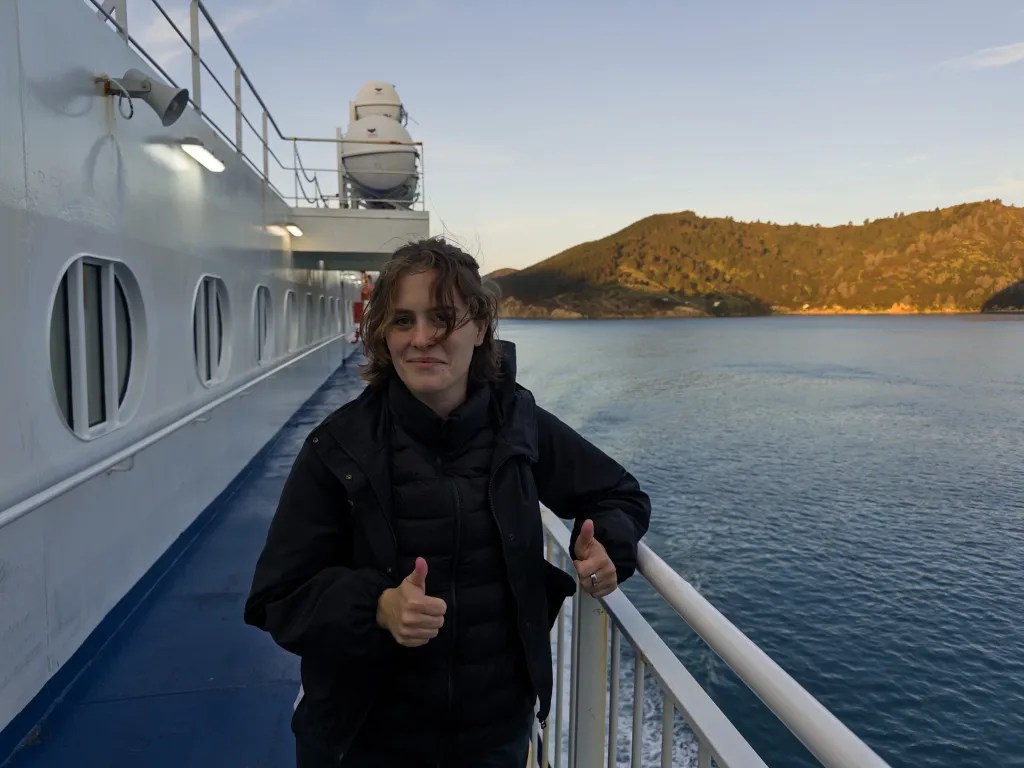
Wellington was cool. We stayed in the Waterloo hotel, which Queen Elizabeth II’s entourage stayed in in ‘56 during her coronation tour and we had Malaysian food for dinner and I had a $2 sausage for breakfast. We took a photo of it and I don’t really like to look at it because the sausage looks like the sort of thing you shouldn’t even touch, let alone pay money for. We caught a ferry to Picton on the north tip of the south island, and the ferry ride was as calm as the process of getting to the ferry wasn’t. Half an hour before final check-in we discovered that the ferry terminal we were standing at had been closed some years earlier, and as the booking email had no indication of where the boat left from, we had to do some rapid googling while walk-running in the direction we thought was right.
For most of my life now people in their 50’s, mainly my parents, have told me what it was like to travel pre-internet. To me, and I don’t know if they meant to communicate this or not, there’s an implication that not only was it harder back then (it probably was), but also that I am lucky to be the benificiary of such a wonderful tool, and to my surprise I’ve spent the past week cursing the internet more than thanking it.
It’s been helpful, of course. There’s an app that shows you free campsites and an app that shows you the cheapest gas, and we were able to book the six hour bus ride from Picton to Christchurch not even 10 hours before the bus departed. But at the same time the internet rewards neurotic pre-planning and punishes spontaneity. There’s no buying tickets at the desk. We’ve found campsites booked out weeks in advance and ferry tickets that get more expensive by the day. Half the information we’ve found online is outdated – it seems New Zealand is a radically different place to travel than it was before the pandemic – and plenty more of what we’ve found online has been flat-out wrong. The most helpful resource, to no one’s surprise, has just been talking to locals. When every coffee shop has an Instagram page and a 4.8 star rating on Yelp!, the best way to find a good one is by stopping an old lady on the street and asking where she goes every morning.
I think people talk less because of the internet too. Our first hostel was connected to an app for finding hostels (there are apps for everything. It’s exhausting.) and that app had a group chat function, and that group chat was teeming with messages from residents and future residents. ‘I’m going out tonight, would anyone like to come?’ ‘A few of us are hiking to Mount Eden if anyone wants to tag along,’ and so on and so forth. When we arrived, though, imagine my surprise when almost no one spoke to each other! I’ll admit I’m part of the problem. Spending the last few years bartending has turned me into a confident conversationalist, but it has also made the crisp white drywall conversations that frame polite society feel like labor. Perhaps they are, but I reckon they’re labor in the same way cleaning up your own rubbish and putting away your shopping cart are labor – without basic decorum, we’re no different than chimps.
Picton was cute. Population of about 4000, a little main street, and logging trucks running down it at all hours of the day. When we got in late at night we ate Thai food at one of the two restaurants that was open. We probably should have bought more groceries in Wellington to save a few bucks, but I was and still am hoping to make up the difference with cheap living in the camper van. We stayed in a hostel called The Tombstone that sat next to a graveyard full of flowers. The Tombstone was a good hostel. We sat in the hot tub with an old man who’s lived in Picton for fifteen years. He told us about cutting pearls and earthquakes — every local we’ve met on the south island has seemed to be a bit of an amateur geologist.
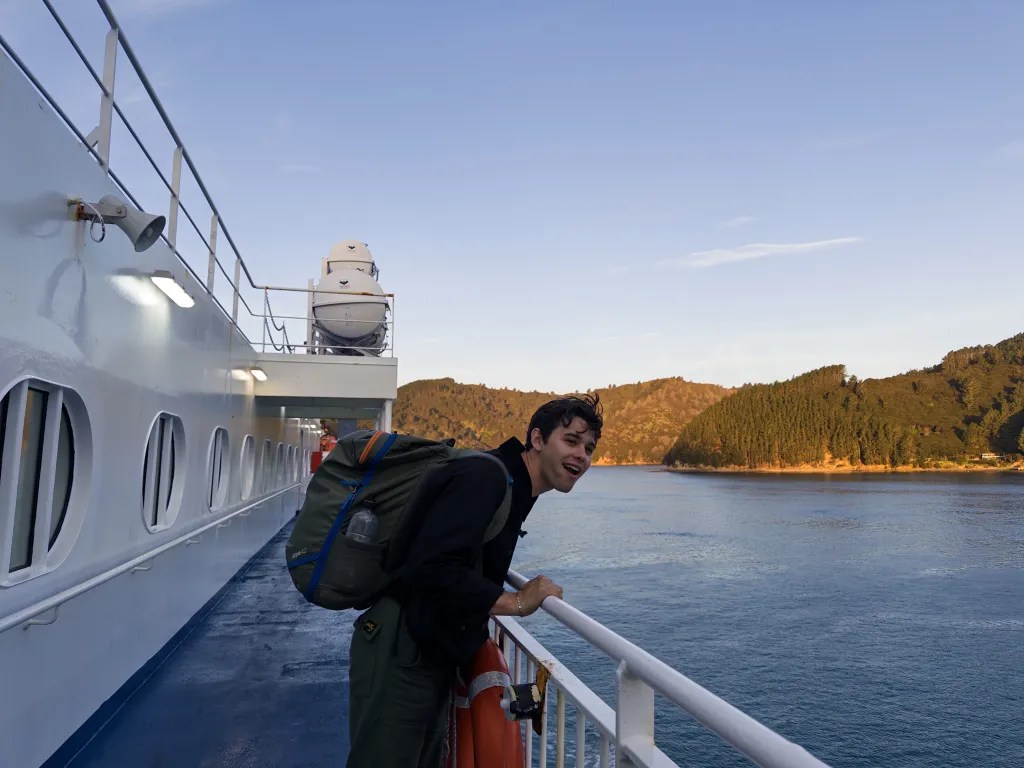
The bus ride to Christchurch was long and a little terrifying. Those mountain roads are slim and winding and the bus driver knew them like the back of his hand – or at least, I hope he did – because he drove like Neal Cassady and spoke like a cartoon character. He told me to ‘speak the queen’s english’ when I asked to get my bag off of him. We stopped in a little sea-side town that was having a classic car show and eventually rolled in to Christchurch. There was a big earthquake a decade ago. It added 80 meters to the coastline and knocked down all of the buildings, so the locals are still rebuilding and quite anxious about the potential for another earthquake. That makes Christchurch “probably the newest city in the world,” according to the guy who rented us the van, and like everyone else we’ve met so far he seemed quite proud of the place he lived.
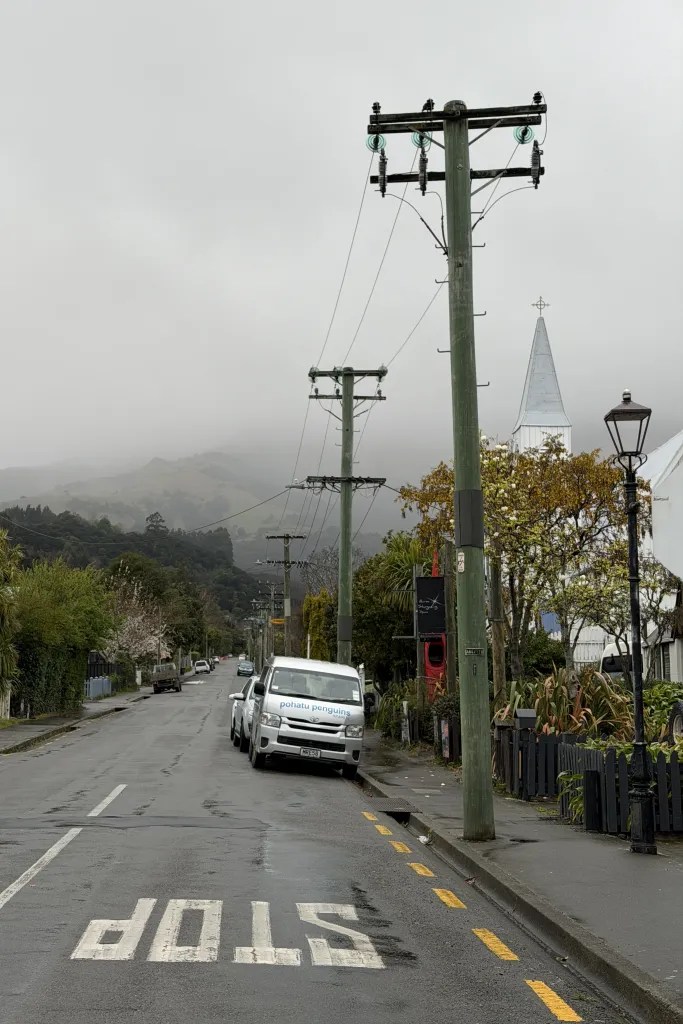
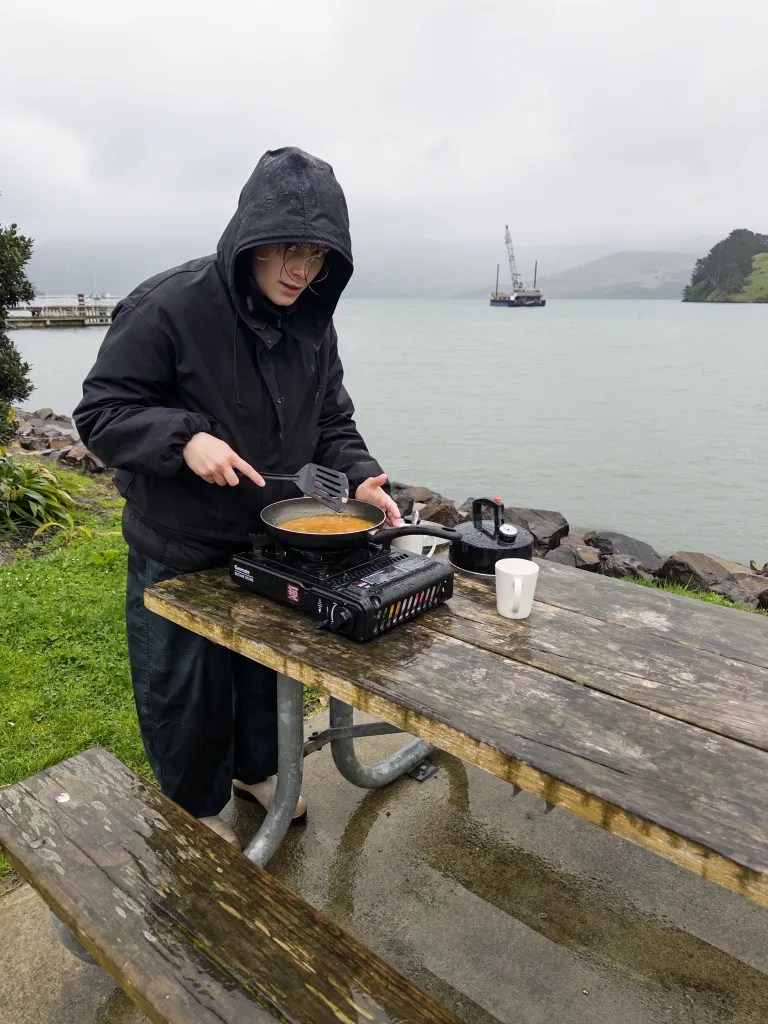
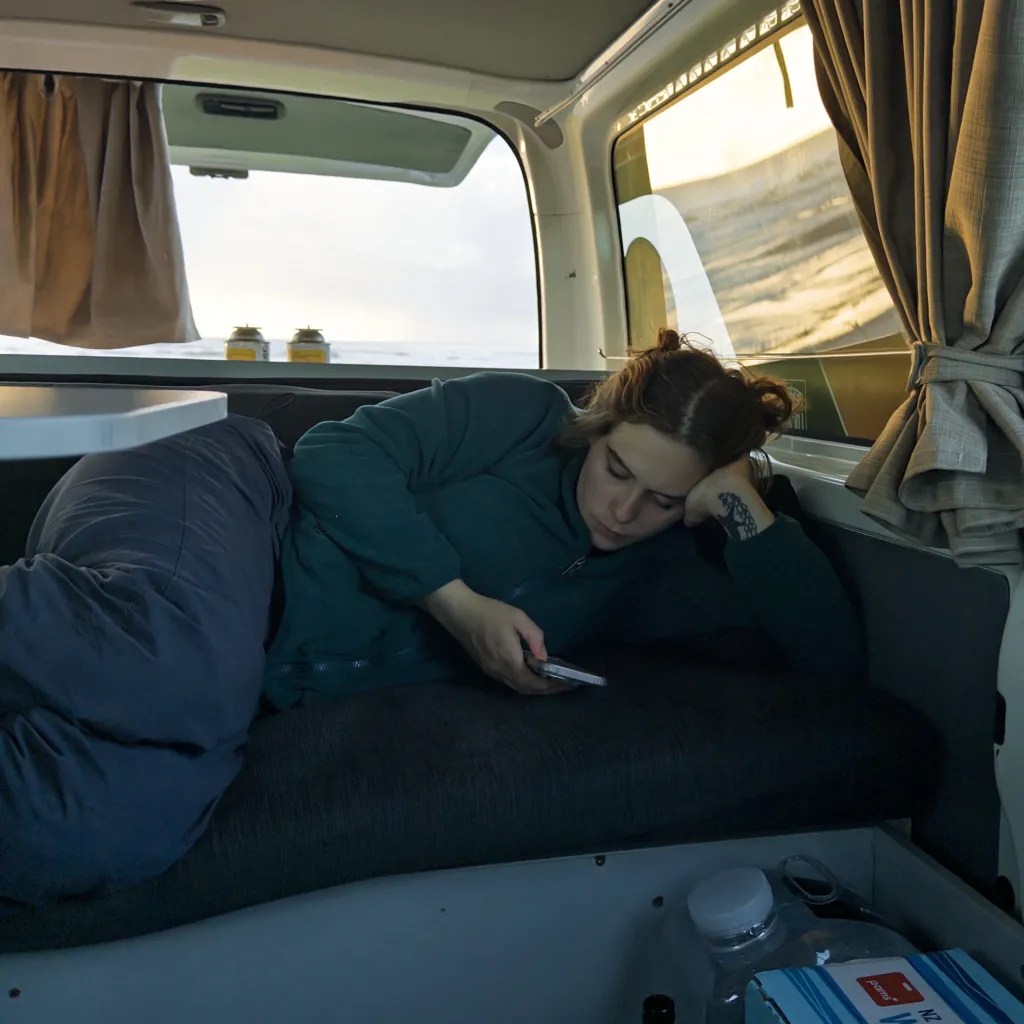
The van is good. 4.4 meters long and 1.8 meters tall. The inside has a little sink and a gas burner that doesn’t really work and a table and benches. The table connects to the benches to make a queen-size bed that we cover in sheets and sleeping bags. We drove the van down to Akaroa, a little port town of about 650 permanent residents that reportedly balloons in the summer months, the winding roads asshole-clenchingly scary in the pitch blackness. Catie drove well, only turning on her windshield wipers instead of her indicators about a dozen times. When we woke up it was foggy and raining and I had a nice run before we slowly cooked breakfast. Our gas burner has an issue where after about four minutes the flames diminish greatly and we have to turn the whole thing off and let it sit for a minute. We’ll try to solve it next time we have internet, which I guess is a big fat tally mark in the pro-internet column. On our way out of town the van’s key broke in the lock, so we used the backup key to drive back to the rental place, then on to a laundromat before heading west in the direction of Lake Tekapo. Lake Tekapo is a real popular spot we assume, because every powered camping site by the lake was booked and the dastardly Canadian working the front desk wanted $54 NZD for an unpowered parking spot. Apparently there’s a marathon happening there today. I’ll try not to hit any runners.
We kept driving down the road until we hit a much smaller lake called Alexandrina, and as the temperature dropped to nearly freezing we slowly cooked broccoli and beef, restarting the stove every four minutes and giving up on the ramen noodles and eating our beef and broccoli on stale 50 cent bread instead. It was all worth it though, because when we climbed back out of the van after dinner with popsicle fingers and nuts the size of almonds we beheld a winter sky so full of stars that the Milky Way Galaxy itself was visible once our eyes adjusted. It was so stunning we almost forgot how cold we were, and wandered around oohing and aahing and taking photographs until our hands stopped working and we retreated back into our sleeping bags to watch a movie.
This morning it is warmer, but I still have the feeling we won’t be doing much hiking on the South Island. Without crampons and ice axes most of the treks are simply too dangerous, and if I’m going to die in my 20’s it will be doing something a lot cooler than attempting a great trek in the offseason without the appropriate gear. The old man in the hot tub said he worked renting out boots on a glacier in the 70’s. He said they’d tell guests “if you slip, make sure you fall face first so we can get our boots back.”
This morning we had yogurt from a farm in Hamilton and granola and bananas from god knows where. The yogurt was incredible. The plan today: find some internet (or even cell service) to book our ferry ticket back to the North Island, find a free camp site with some hikes nearby that we can actually do, figure out if we can fix the stove, and update the spreadsheets I’m using to do our budgeting so we know how much money we can spend without going over budget. Twenty days left in New Zealand and I suspect we’ll be eating a lot of bread and cheese. In the next few days I’d like to visit some wineries (great wine on the South Island) and hopefully end up in a decent-sized town on Sunday for the big Rugby game. New Zealand has one team, the warriors, and they play in a league with about 15 Aussie teams. Sunday is the semifinals, and it’s a big deal.
I’m driving today, which makes me feel a little anxious, though to be fair I feel anxious driving in the states, too. These Kiwis drive like maniacs, but I can too.
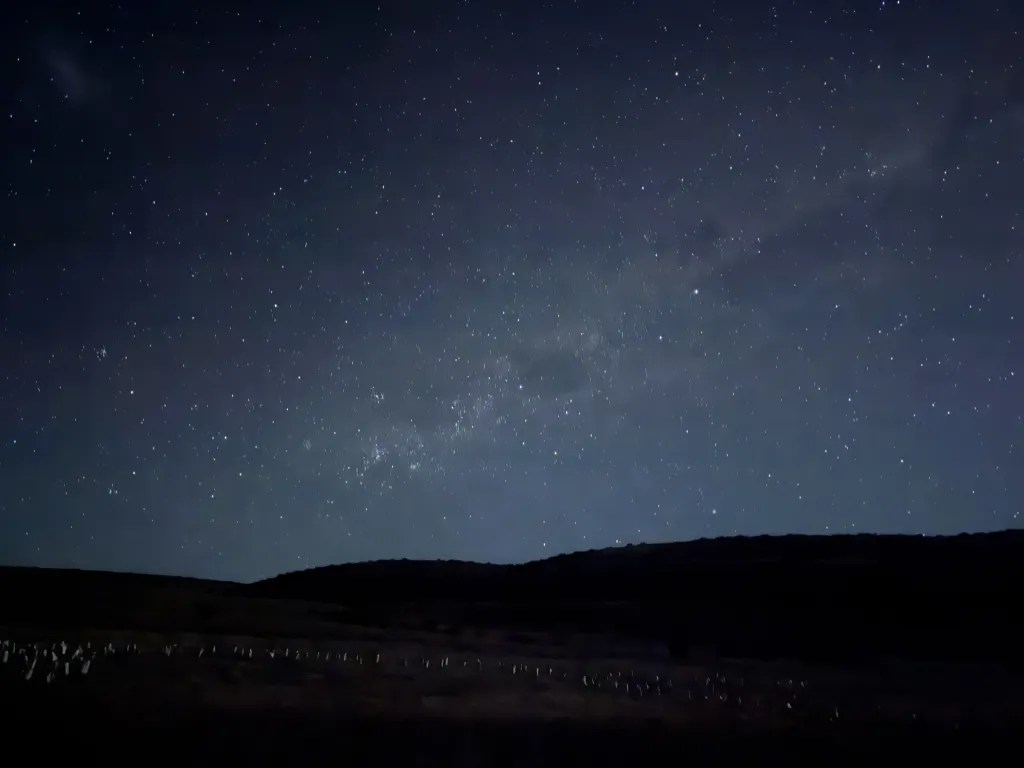
Warrington, New Zealand, Saturday September 19th, 7:54 am.
Catie doesn’t love it when I drive. The roads here are usually great – big lazy corners with beautiful grading and fat long hills to strain upwards and fly down. Sometimes when the road is old and patched dozens of times it starts to throw our shitty little van around and Catie holds on to her seat for dear life. Every big semi and work truck in the country must be outfitted with a sort of sensor that lets them know that I’m driving on a sketchy road, because a dozen of them at a time will come flying by six inches from my driver’s side mirror and between the road and the draft I am sure that the wheel must inevitably pitch right and I will crash straight into the side of some hulking lorry.
We drove East yesterday. The internet says lake Alexandrina hit -3 C (26.6 F) two nights ago, and we’d like to avoid that kind of weather for the time being. We hit the coast and turned South, making for Dunedin, and we pulled into town at about 4 pm. Dunedin (duh-NEE-din – I think) is a cute little college town with a beautiful bay and big rolling hills with bungalows perched on them. We visited a house my mum’s school classmate had built, the Kingsbury Glasshouse, a big half-barrel of glass with plants in the middle and half a brick house on either side. We stopped at the local settler’s museum, which proudly recounted the history of Dunedin’s initial residents back in the 1800’s. Catie and I noticed that there wasn’t much discussion of colonial brutality against the local indigenous folks, which leads us to two possible conclusions: either the settlers and the local Maori got along swimmingly from the jump, or perhaps the settlers museum isn’t representing the true complexity of rocking up to a place that’s already been inhabited for hundred of years. In our week here in New Zealand we haven’t seen much discussion at all of colonial violence at all, but we did see a protest at the capitol in Wellington, and we were happy to participate in it because we Americans love protesting almost as much as the French. We might not have a right to cast judgement though, back in Bellingham you’d be hard pressed to find Lummi or Nooksack writing or markers of culture anywhere besides tribally owned businesses, and here Maori seems to be treated as a second national language.
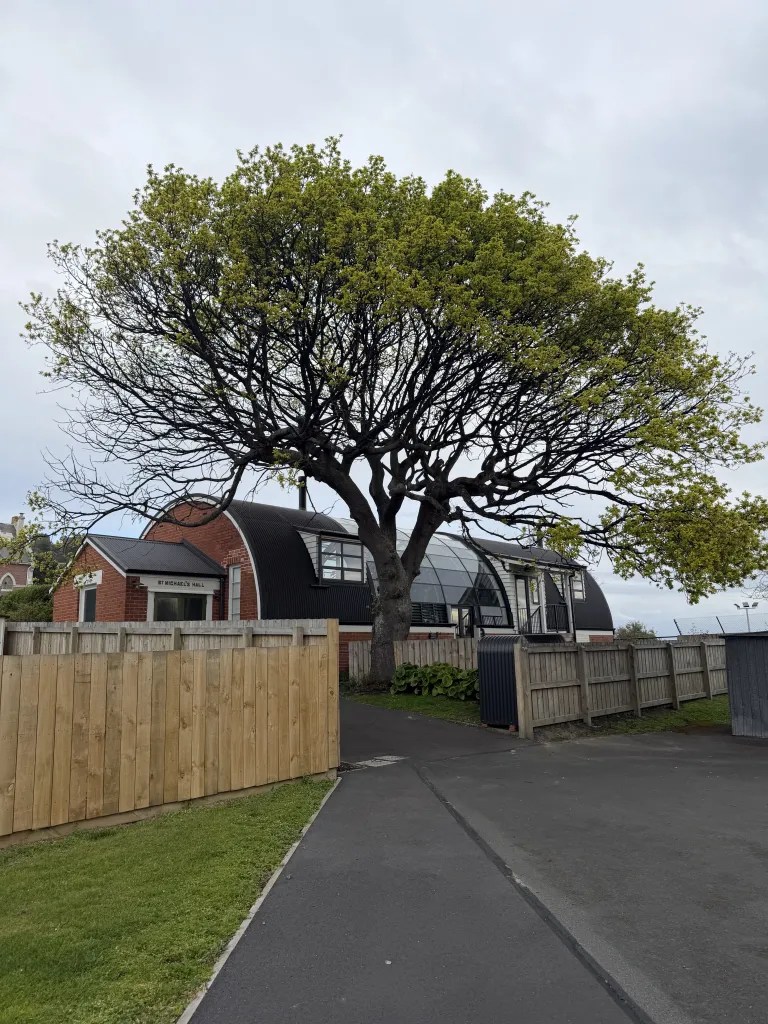
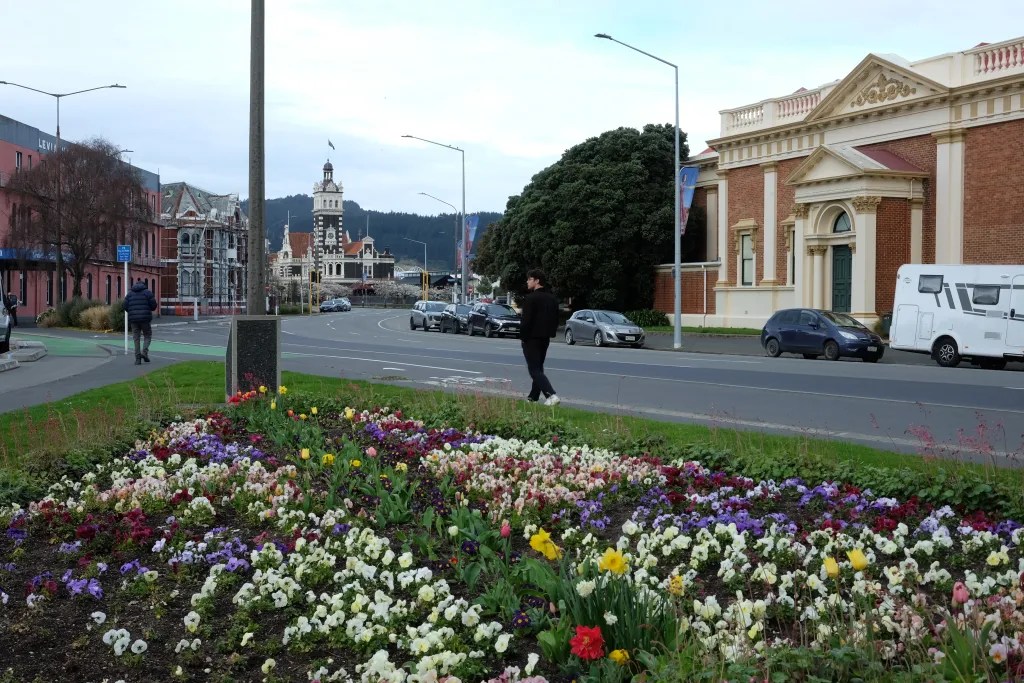
Catie has just cooked breakfast; a bread roll (50 cents) fried ham ($1) two eggs ($1.64) and a little butter and mayonnaise (priceless) with instant coffee. It’s delightful. Last night was a little sad. Catie’s feeling homesick and somehow I am too. I say somehow because I’m not really sure what I’m homesick for. I don’t miss Bellingham and I don’t miss my friends, whom I know I’ll see again in a flash. I don’t miss my parent’s house, which will always be home but hasn’t felt like it for a few years now, and I don’t miss my job. I guess what I do miss are certain feelings: Maru gently biting my cheeks to wake me up for breakfast, Tegan meowing at me for dinner, sitting on the couch after a long day. The cats are home more than anything else, and I miss them exactly as much as I expected and somehow it’s still devastating. I remind myself that my mum is taking great care of them, and that they’re in a much bigger house than I could ever afford with a sweet dog and a lonely old-man-cat who needs company and just the right number of people, but I miss them still.
Breakfast is done and was delicious. In twenty minutes or so we’ll head off to Nugget’s Point, only an hour or so’s drive away, and spend a luxurious evening at a paid campsite with showers and wifi and all the amenities. We’ll relax and recharge before heading to Queenstown tomorrow – there’s a big rugby game on at 6 and we’d like to watch it in a relatively busy pub even if beers do cost $12 here.
Kingston Road, New Zealand, Tuesday September 22, 10:04 am.
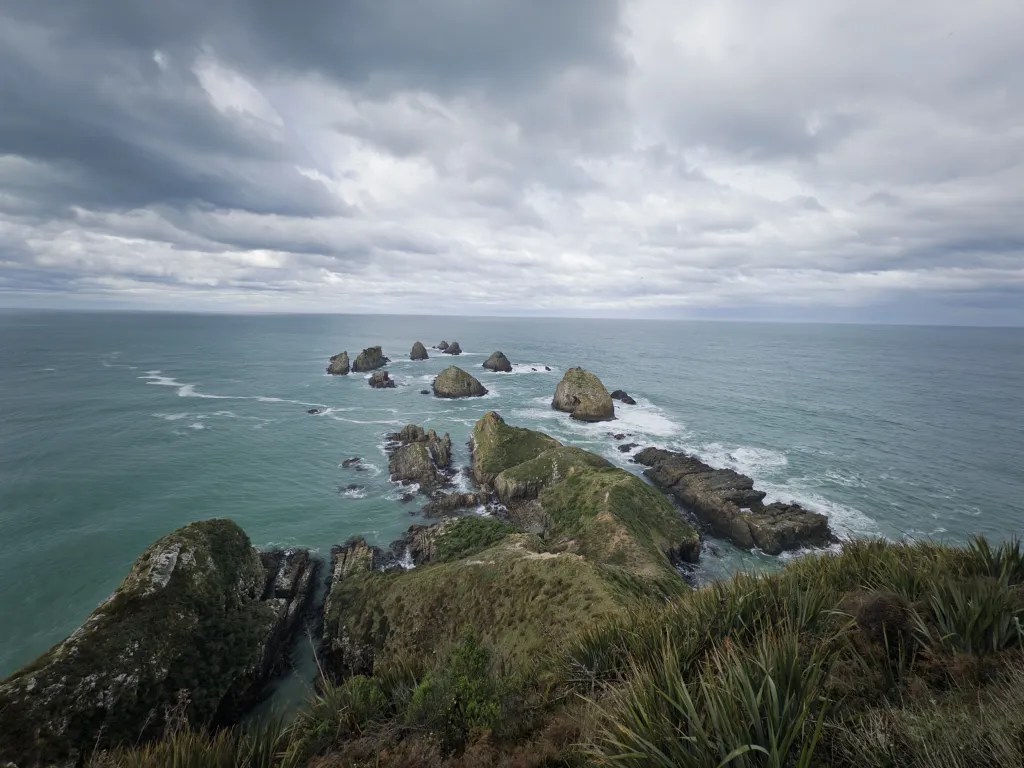
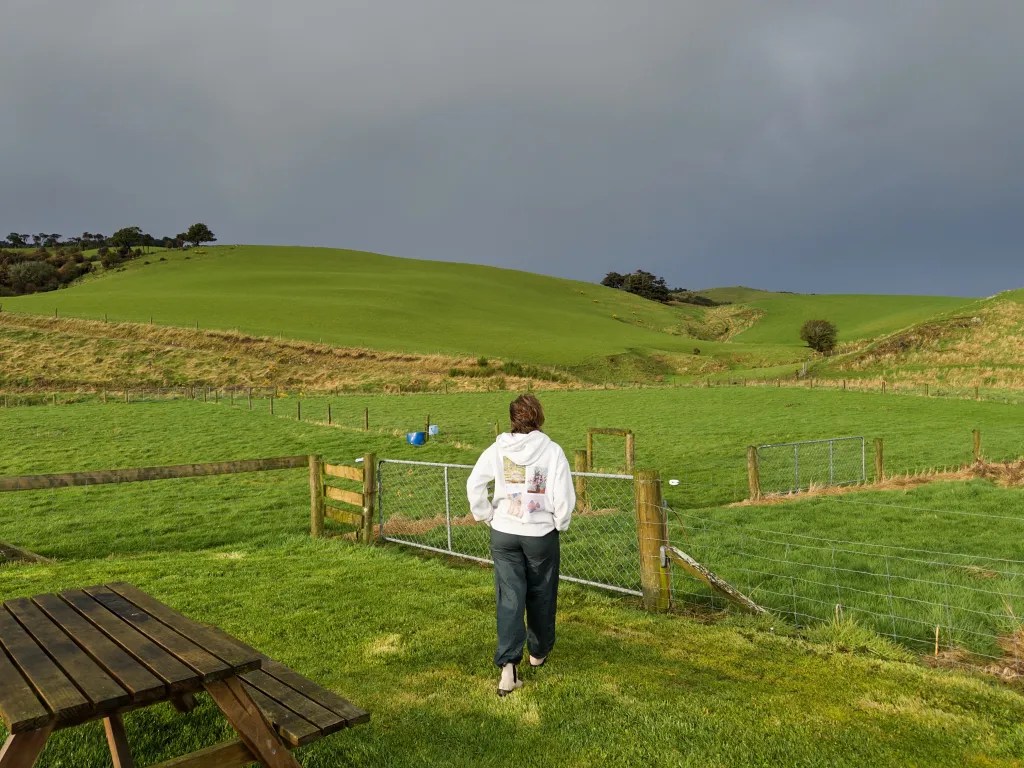
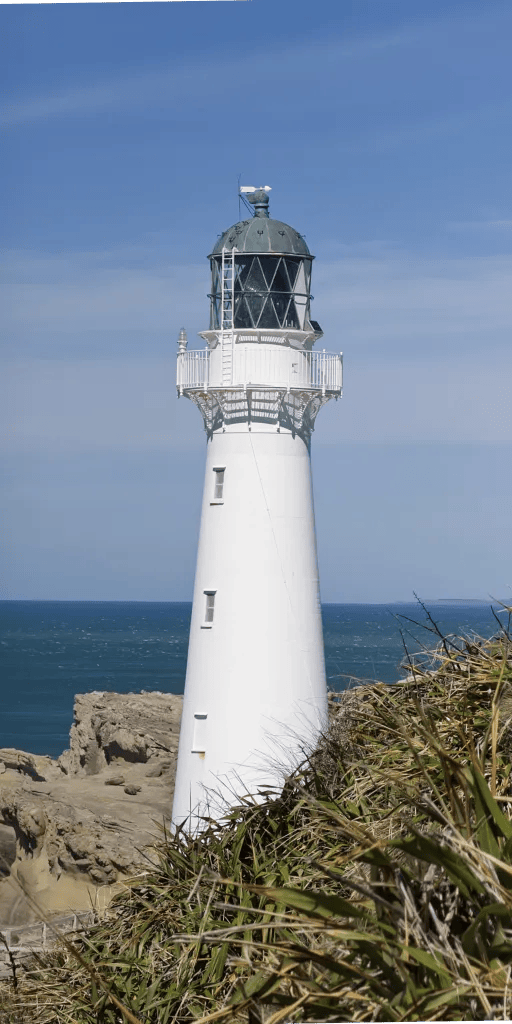
Nugget’s Point was beautiful. Big verdant peninsula with crashing blue waves on harsh rocks down below and a lighthouse at the tip all white and geometric glass. Our campsite was some guy’s back field. Big bald man with a strong round belly and a six year-old daughter and an orange cat with no name. He had six acres, which fill up with campervans in the summer but only had one other van when we arrived. Two sheep in a back paddock, a big extension cord for our van to plug into, and the cleanest bathrooms so far. It was lucky we had power, because the wind and rain rocked our van all night and we couldn’t open up the van to cook. We plugged in our little heater and charged our devices and hunkered down, and in the morning when we discovered his showers didn’t work I was too polite (or too cowardly) to ask for help, so we washed our hair and armpits in the outdoor sink and shivered like hell. We drove West through a series of small towns, mostly empty on a Sunday. Rural New Zealand is pretty quiet and in a lot of places you could tell that everyone knew each other and also that you didn’t see too many tourists. We parked and had fish and chips in a town called Alexandra while the community theater rehearsed Footloose nearby.
Our plan was to stay at a winery that night. For $10 NZD per person we could have wifi and electricity and a complimentary wine tasting at 4 pm, so we drove beside the Clutha river and through some of the most beautiful forests I’ve ever seen. They filmed the Lothlorien scenes in the Lord of the Rings movies in those forests, and their otherworldly beauty was only occasionally interrupted bywork truck flying pasts us at 120 kph.
Otago feels like a modern-day Garden of Eden; wide valleys ringed by mountains and filled with orchards and grape vines. We arrived at our chosen winery and foolishly ignored the big “CLOSED” sign out front. For the most part campsites aren’t booked online here. You just pull up, pay in person if you have to, and go about your day. As we drove up the long narrow driveway though, with hedges to our left and a little one-story house to our right, Catie exhaled sharply.
“There’s a naked man on that porch,” she said.
“Shit,” I said, but we were stuck in the middle of the driveway and the only thing to do was keep driving. The man was curled up in his deck chair in the fetal position — butthole to the sky, Catie says — though I thankfully didn’t see him because I was focused on his long and skinny driveway. He stood up (reportedly) as I pulled into the space where campers usually debarked from their vans. As I performed a rapid two-point turn I admired the amenities advertised in the listing: five room stone building, stairs leading to an underground wine cellar, ancient tractors and farm equipment and rows and rows of beautiful vines ready to come alive in the approaching springtime sun. I drove back down the driveway at twice the speed I went up it, and then we were back on the open road with no wine to taste and nowhere to sleep.
We drove into Clyde next, a sleepy town of about 1000 with a vineyard up on the hill that had said it was open online. This one looked empty, but not to be discouraged we drove down their even narrower driveway before getting stuck halfway and awkwardly backing out of it again. At this point a man in his 70’s came out on the deck and invited us in. He seemed a bit drunk and we got the sense that we had interrupted he and his wife’s lunch, but it was too late to back out now so we gamely sat for a tasting and politely bought two bottles of his wine. He owned the land but he wasn’t the winemaker, so he couldn’t answer many of our questions, but he gave us his son in Melbourne’s phone number in case we need a place to stay over there and gave us a big old discount on the wines, so we left feeling a little rude and very grateful.
Our next campsite was a great big parking lot on Lake Dunstan outside the town of Cromwell and it was probably the most pleasant one we’ve had to date. We found a wine retailer on the side of the road that does tastings for vineyards that are too small for their own tasting rooms and left with yet another bottle of wine, and the woman who worked at this one owned one of the vineyards in question and was quite knowledgeable besides. The Otago region benefits from high sunlight hours and robust soil, with warm days and cold nights, creating an environment that is conducive to high-sugar high-acid grapes like Pinot Noir and Reisling. I’m not much of a pinot guy but I do love trying new things, and Catie found a funky sparkling Pinot Noir that she’s over the moon for. That night we got drunk on the lake and fell asleep without brushing our teeth.
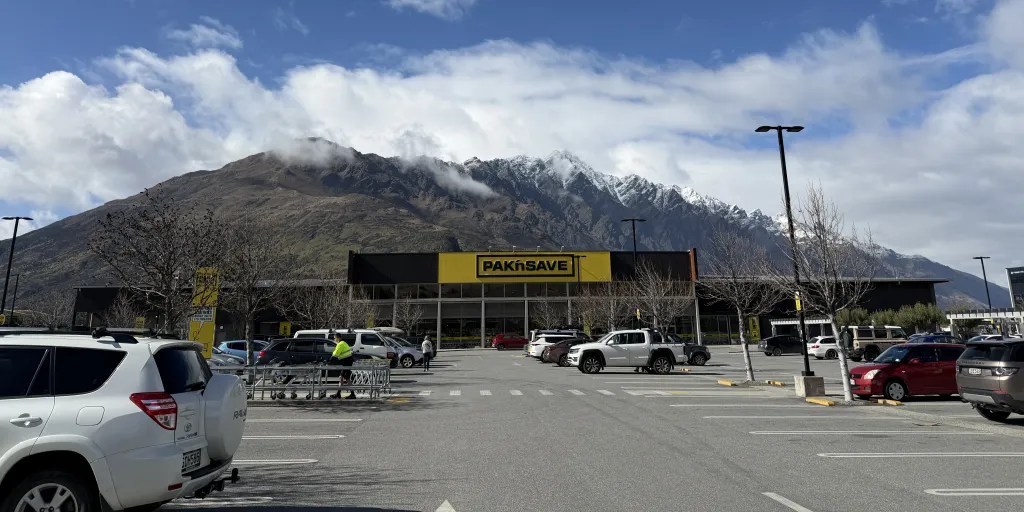
Yesterday was challenging. We drove west to Queenstown, and I booked a rather pricy campsite ($92 NZD) with hot showers and laundry, because we haven’t showered since we picked up the van and I am starting to develop a patina. Queenstown is the most touristy place on the South Island, and as we wandered around the bustling ski town where prices were 50% higher than in the rest of the already very expensive country we felt almost as if we were back in Leavenworth or Whistler. At our campsite we discovered that I had accidentally booked for the following evening, and they politely but firmly informed us that they did not provide refunds and would not be moving our booking up one day even though they had the space. Assholes.
Catie and I threw a tantrum in the van while the wind made rainbow waterspouts on the lake. Eventually we pulled ourselves together and went grocery shopping before driving ten miles down the road and camping at a free site beside the same lake. Lake Wakatipu is the longest lake in New Zealand, and it is big enough that it has its own “tide” that comes in and goes out in a 25 minute cycle. Last night it was real windy and rainy, and we ate steak and potatoes as the big fat raindrops hit the roof of our van. The food has absolutely been the highlight of our trip so far. For less than the price of groceries in America Catie and I have enjoyed meat, butter, milk, and vegetables grown and farmed and harvested at most a few hundred miles from us. If I wasn’t eating so much chocolate and drinking so much cheap beer I’d probably look like Adonis by now.
Queenstown has been the lowlight, and tonight we’re going back to that stupid campsite for our hot showers and laundry. Resort towns all feel the same to me. You pay through the nose for comfort and reliable mediocrity, and in the process you have to strip away so much of what makes a place special. Not a lot of personality in Queenstown – it’s a theme park that sells Patagonia puffers instead of Mickey Mouse ears. Still, it’ll be nice to shower and clean our stuff, and then we’re off up the West Coast. Smaller towns, harsher weather, and scarier roads. Sounds delightful. In just a week we’ll be catching a ferry back to the North Island, and then a week after that we’ll be on a plane to Brisbane. Time flies when you’re having fun.
Bendigo, New Zealand, Thursday September 24, 6:16 pm
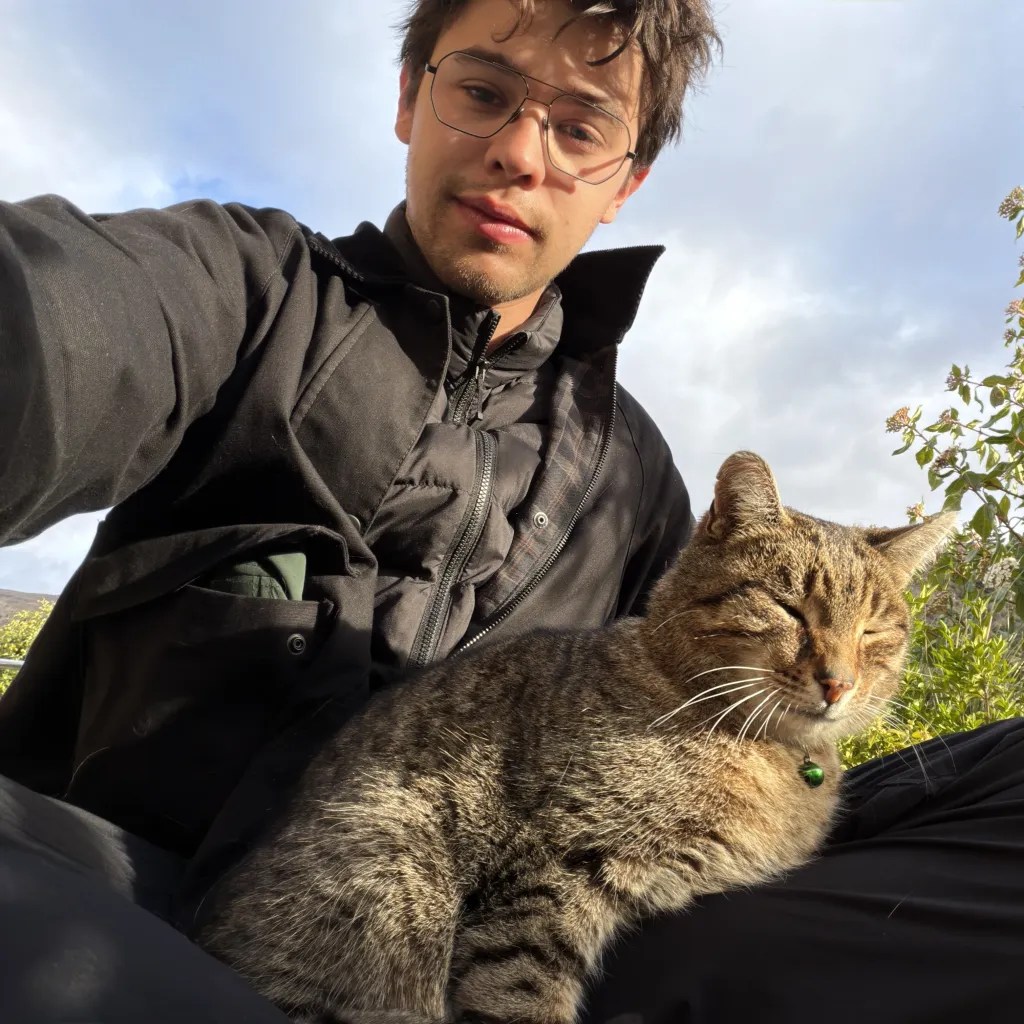
There comes a point in every young man’s life where he decides to find out whether or not he is capable of growing a beard. We all want to at least have the ability to grow a big thick manly hock of hair on our cheeks, and we hope that it will make us look like vikings or action heroes or Hollywood heartthrobs instead of the insecure little boys we know we are deep down. It should happen effortlessly, one feels. You forget to shave one day and don’t mind how it looks so you skip the next, too, and in a week or two your fashionable five o’clock shadow has grown into a full-on real deal crop of facial hair.
The fear is in finding out that you are not able to grow a beard. The people in your life know (subconsciously and approximately) how often you shave your face, and if you try to grow a beard and fail there will come a day where your friend or classmate or coworker looks at you and realizes that things have gotten a little longer and a little whispier than usual. At that point you have two options and they’re both bad: either admit defeat, shave your whispy little boy-beard off and pretend it never happened, or doggedly hang on in the hopes that some of your follicles were busy doing other things and that they’ll totally get right on that whole growing thing right away sir.
I am a coward and I couldn’t bring myself to try when the same people saw me every day. I’m very vain besides and would like the people who see me to think I’m very handsome, so every time things drifted away from ‘fashionably unkempt’ and towards ‘not allowed within 500 feet of a school’ I would bust out the old safety razor and scrape my cheeks clean. Safety razors aren’t allowed in carry-on bags though, and so I decided to finally find out whether I could grow a beard.
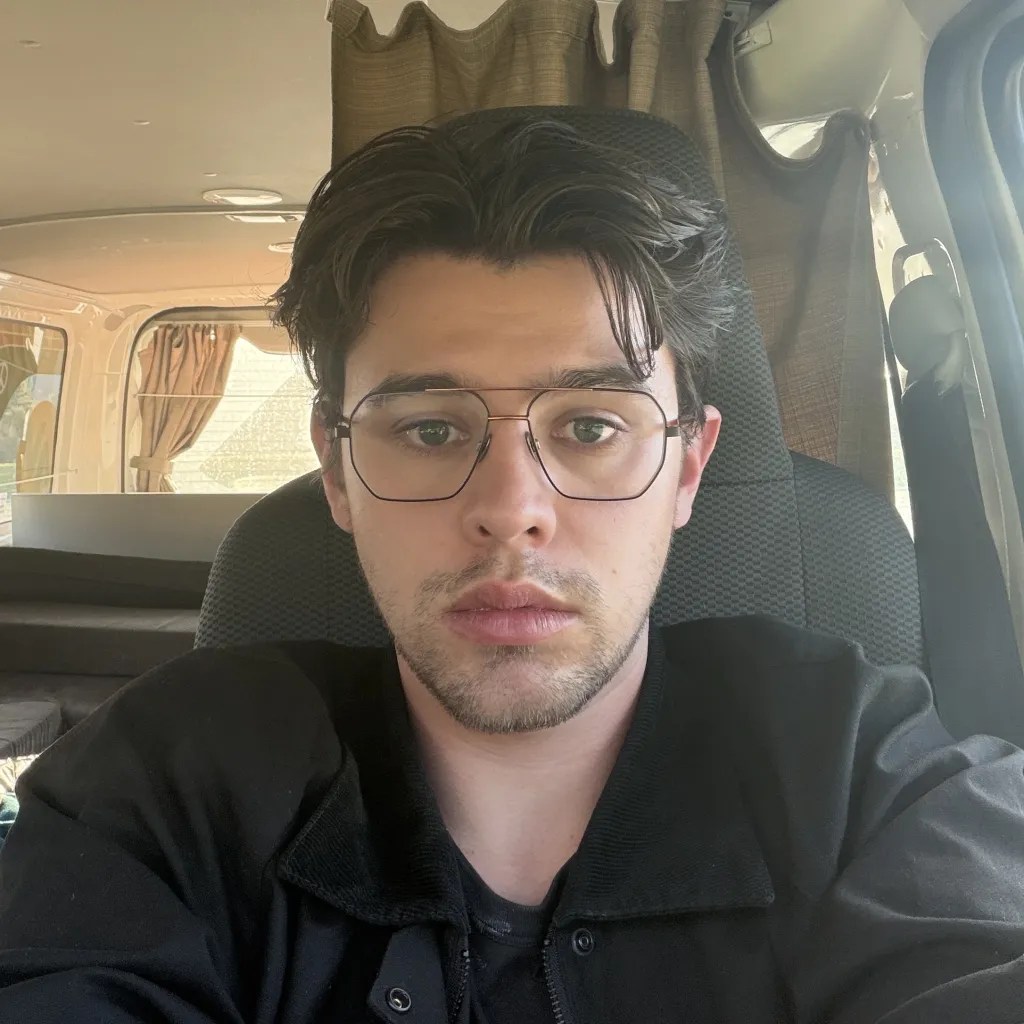
For the last seven years I have been wearing contact lenses almost every single day. I love how I look without glasses and I love not having to wipe smudges off of them and I’ve been happy to deal with all the downsides of putting little plastic plates on my eyeballs. Unfortunately my current pair is about two years overdue for replacement and my new ones didn’t arrive in Seattle until after I left, so for the time being I can only wear my contact lenses for about six hours before they hurt too bad to wear and I can’t see very well out of them and they’re scratching up my corneas. My mum is sending my new pair on ahead to Australia, but in the meantime I am wearing glasses all day every day for the first time since I was fifteen years old and I’m feeling a little self conscious about it.
I gave up on my contact lenses before I realized that I was testing out my beard growing capabilities. We had just picked up the van and my four days of stubble wasn’t looking too bad. Catie told me I looked good, even, so I decided not to shave. I told myself I was being nonchalant about it, but I wasn’t. For the last seven days I have stroked my face with obsessive frequency. I have felt the hairs on my chin grow soft and stared into the mirror, wondering when the hair on my cheeks would come in as thick as the stuff on my neck.
It didn’t, and we spent at least five of those days without showers either, so I wandered from town to town with my thin whispy beard and my crazy bird of paradise hair and a pair of glasses I didn’t quite feel comfortable in. Today I looked in the mirror at a campsite bathroom and made peace with the fact that there weren’t more follicles waiting to push their way out of my face until the first wave had reached maturity. Real men with real beards don’t have an awkward stage where they look like a freshly hatched gosling. I warmed some water on our camp stove and I shaved it off.
I am excited about the grooming opportunities world travel provides. Maybe next I’ll grow out a mullet, then maybe I’ll shave it all off and bleach my round head blonde; but regardless of how crazy my hair gets I won’t wear a mustache with my mullet, because I know that for the time being all I can grow is the ghost of mustache future.
It’s been a good couple days on the road. We went back to that campsite in Queenstown that we had booked for the wrong night, bought more groceries, got Catie a new pair of shoes, had a few beers and a few hot showers. We met a Chinese girl in Wellington and kept seeing her as we traveled – on the ferry to Picton, on the bus the next morning, and again in Christchurch. Catie got her Instagram and her name is Kiri. She was going on a tour of the South Island to celebrate getting her Master’s Degree at the University of Auckland. We met her in a pub in Queenstown and made friends and it was a lovely time. We walked the hour back to our campsite in the cold and bought McDonalds and felt ashamed of our gluttony.
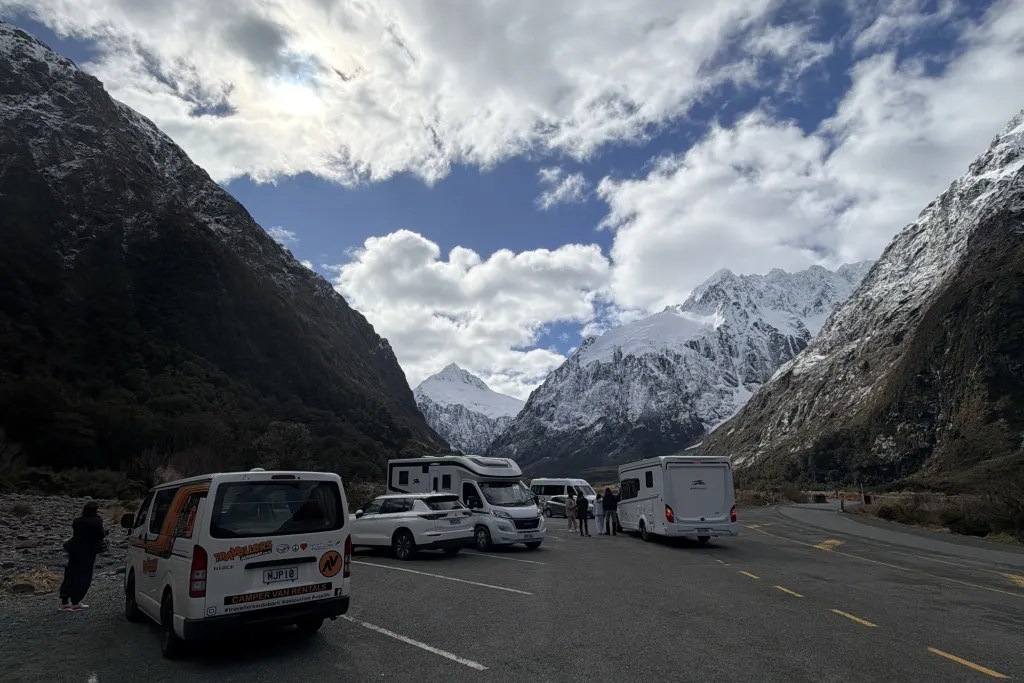
Yesterday we drove South to Fiordland and down into the Milford Sound. Making no plans and possessing no expectations has been one of the most exciting things I’ve ever done in my life and I’m going to keep it going for as long as I responsibly can. I had no clue what the Milford Sound was, but Catie wanted to go and I figured that a place called Fiordland must be pretty beautiful because of the whole ‘fiord’ part of the name. Boy were we unprepared.
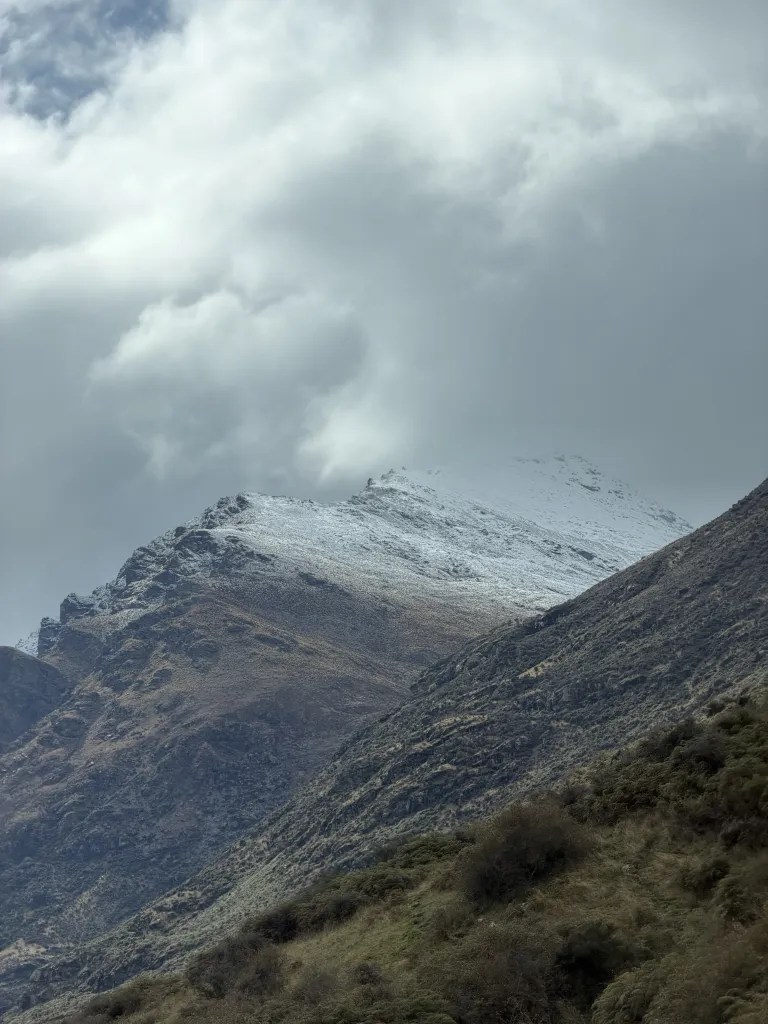
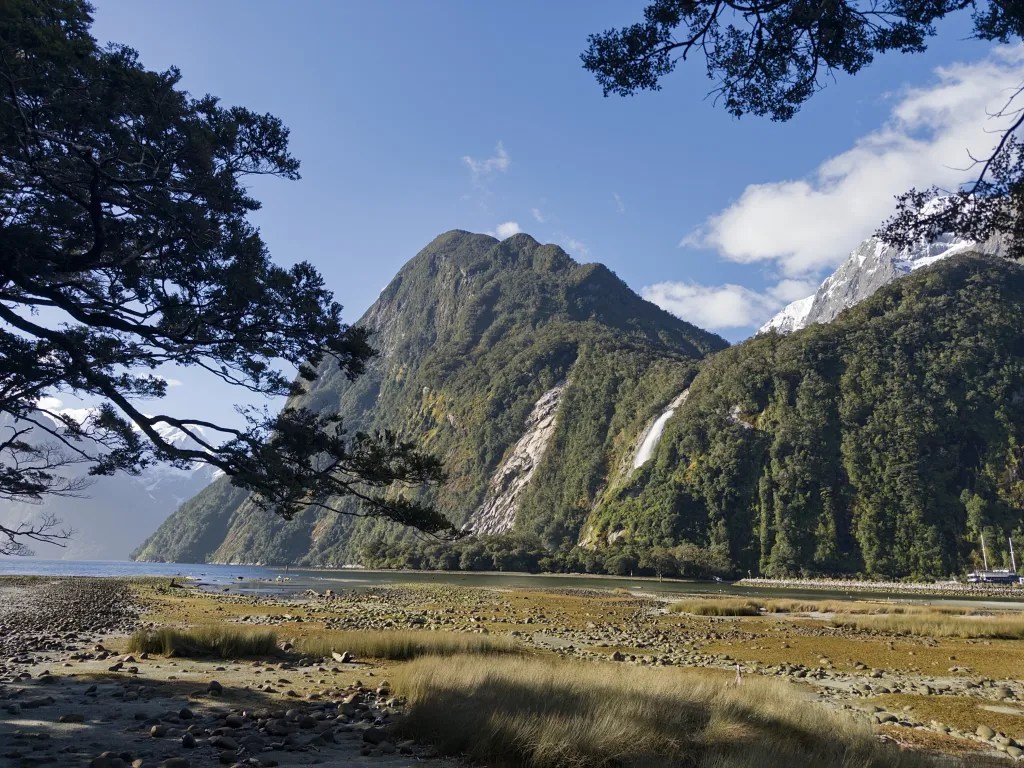
The drive to Fiordland is long and winding. You go through dense forests and come out into golden fields with short mountains to your left and hills to your right. The road gets thinner and windier as it goes upwards and the trees get scragglier and spookier. Some of the Mirkwood scenes from the Hobbit movies were filmed here. Behind and above the trees are mountains, and they shoot up so suddenly that even we who are spoiled for mountains in the Pacific Northwest felt that these were impressive. Their tops are dusted with snow and their sides run hard and sheer when they aren’t obscured by fluffy clouds.
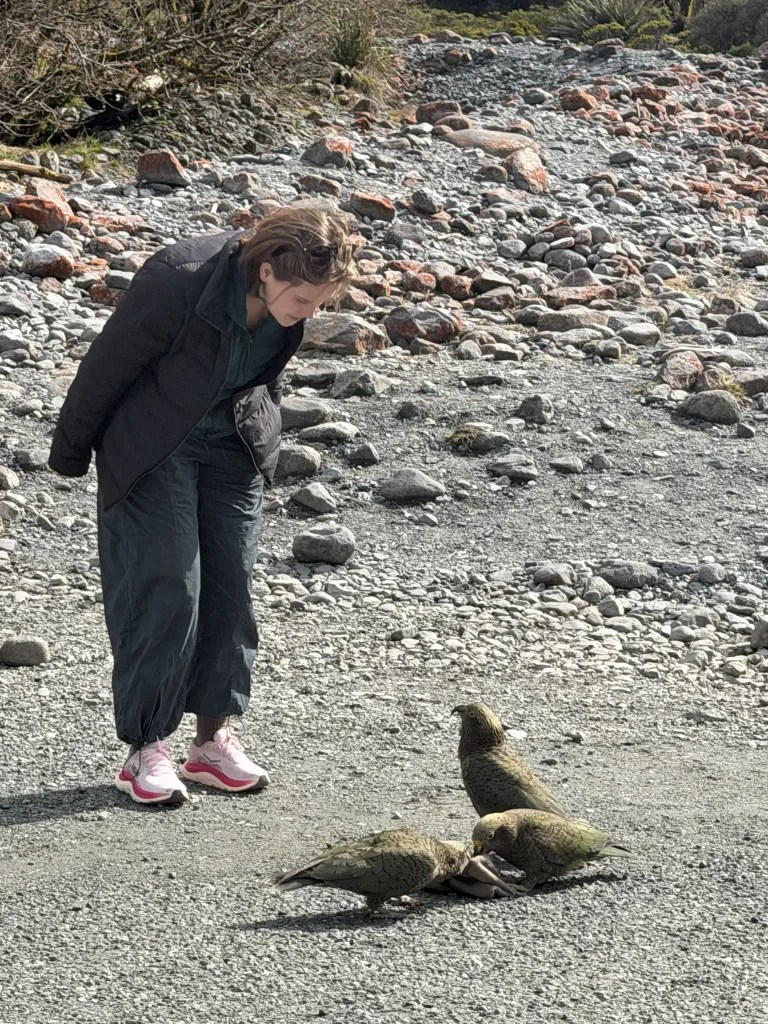
We pulled off to the side of the road. Catie was getting nervous that I was going to careen off the shoulder and I was getting nervous that if I drove any longer she wouldn’t be able to detach her clenched fist from the van’s assist handle. As a much larger camper van pulled out and back onto the road big birds descended on its roof. They landed, stomped around, and jumped back into the sky as the van picked up speed. They were called Keas, a type of parrot that lives in the mountains, and they gave Catie a hat and tried to strip the rubber from our car.
As you climb and climb up the steep and winding road you reach a tunnel with very official stop lights and security cameras and a big screen that tells you to wait three minutes before driving forward. Once you’ve waited the screen tells you in all caps to turn on your headlights and drive slowly, and off you go into a tunnel that feels a kilometer long. You come out into a covered structure and then the structure falls away and you are in the Milford Sound and you try to say something witty but the only thing that comes out of your mouth is air in short little gasps.
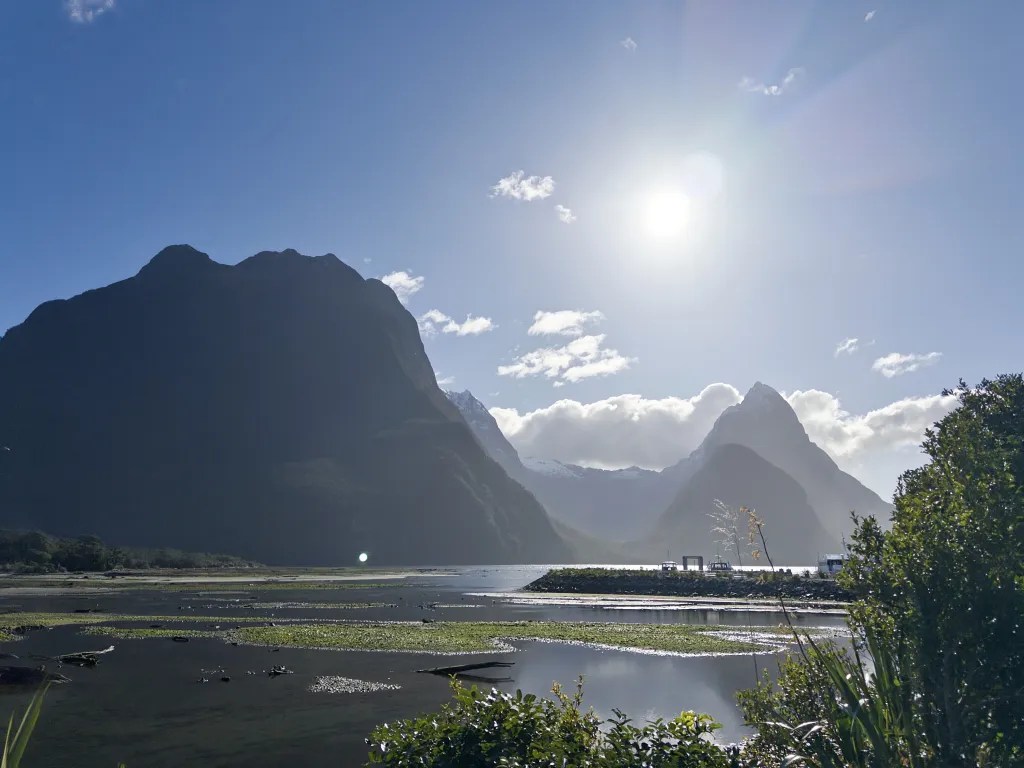
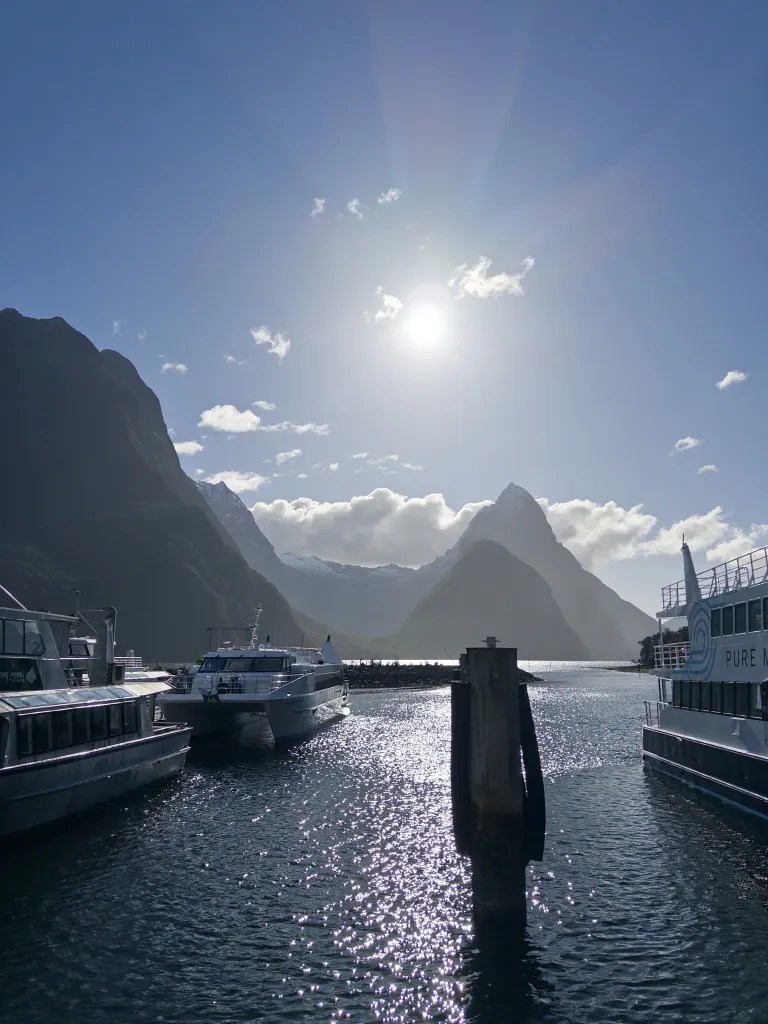
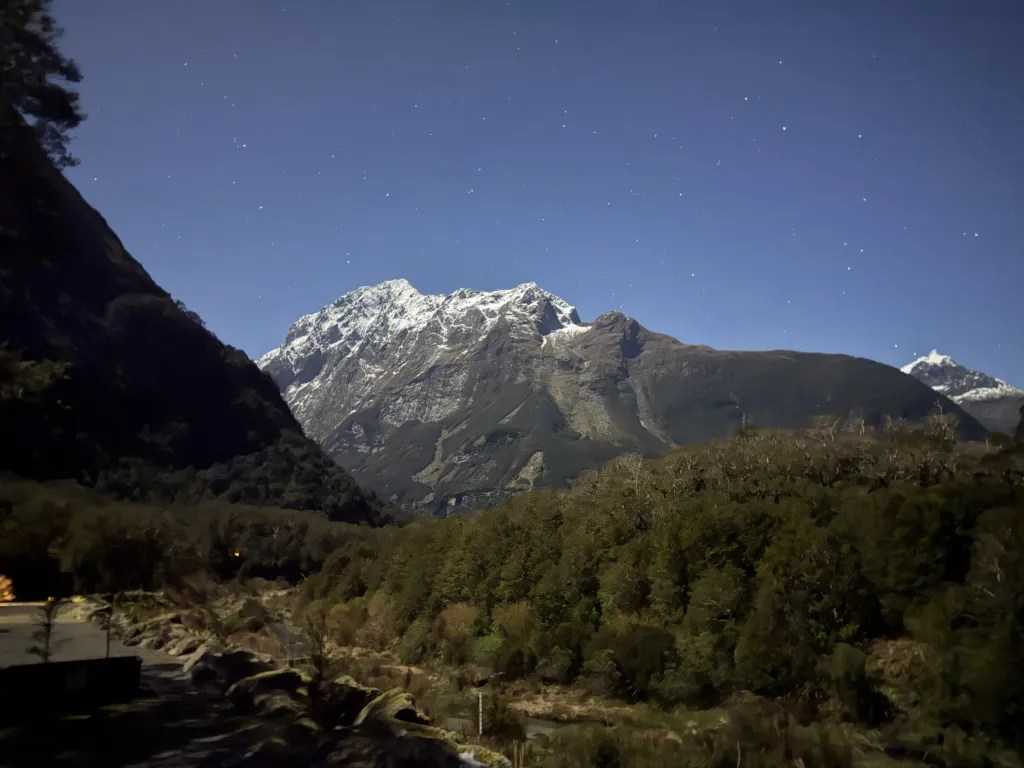
The Milford Sound is the most beautiful place I have ever been and second place doesn’t even come close. The valley is ringed by those same mountains as before, but these ones feel higher and steeper and they are covered in trees. Waterfalls pour from snow covered peaks into bright blue rivers that wind along the valley floor. Clouds tickle mountaintops as the sun sits high in the sky raining gold and glory and goodness.
We drove slowly and carefully down to the valley floor, saying clever things to eachother like ‘wow,’ and ‘I’m at a loss for words.’ At the bottom is small hotel. You can rent chalets for $400 a night and parking spots for your camper van for a little less, but we couldn’t because we checked online and they were all booked. When I was looking online I hadn’t cared. Everyone in New Zealand had been trying to get as much of my money as possible since we landed, and I wasn’t in the habit of feeling sad when I couldn’t give it to them. Driving down to the bottom of the Sound was another story though. Catie parked outside and I waited patiently as a family of four and a couple in their 60’s checked in. Catie and I have been younger than nearly every person we’ve seen. We’ve been younger than the staff at a lot of these places. I rehearsed my line in my head a dozen times,
“I think I know the answer but I’d be a fool if I didn’t ask – do you have any spots available for a self contained camper?” I told myself that I could do this. I told myself that it was good to practice experiencing rejection. Instead, the 30 year old Canadian at the front desk asked.
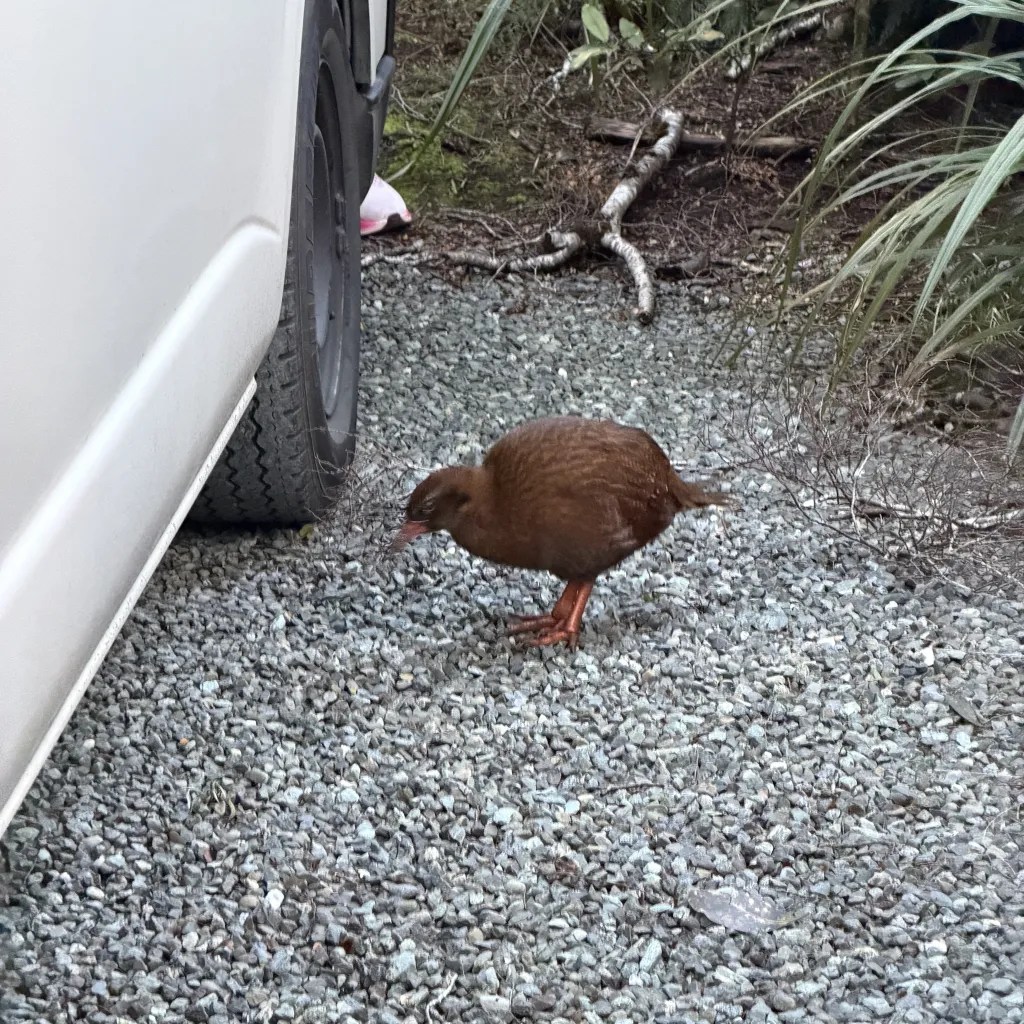
“How long is your camper?” and I knew we had it. $120 New Zealand Dollars well spent. We drove down to where the fancy cruises and airplanes take off from and walked around. We got a cocktail at the bar. Catie was so excited that she convinced me to get another. We filled our water bottles with water from a nearby waterfall and cooked chicken and drank wine while a flightless bird called a Weka begged from us.
The Milford Sound is supposed to be prettiest in the rain, which is convenient because it’s one of the rainiest places on Earth. The internet says that the clouds crouch on the mountaintops and waterfalls spontaneously stream down rockfaces. I don’t give a shit, though, because we were there as the sun set and we were all alone and we felt like the luckiest people in the world. I know with one hundred percent confidence that we appreciated the beauty and splendor of the Milford Sound to a degree that no one who could afford the $1400 helicopter ride with remote-mountain-peak landing on the most perfect, rainiest day ever could.
This morning we drove back down to the car park. It costs $10 per hour before 5 pm, and every spot was full. The planes were taking off and the cruise ships were sailing out past the harbor and not one of those suckers knew how good they could have had it if they had put their hearts in the universe’s outstretched hand and shut their eyes.
Catie is reading Lord of the Rings on her Kindle and when I read my romantic little passages aloud to her she says “that’s wonderful” and keeps reading.
Picton, New Zealand, Tuesday September 29th, 6:26 am
We are in line for the ferry back to the North Island. A woman in a hi-vis vest is walking around making all the cars scoot closer to each other, and in twenty minutes registration will close and hopefully soon after that we can ease our way onto the ferry and park where they tell us and then go up to the observation deck not too long after sunrise.
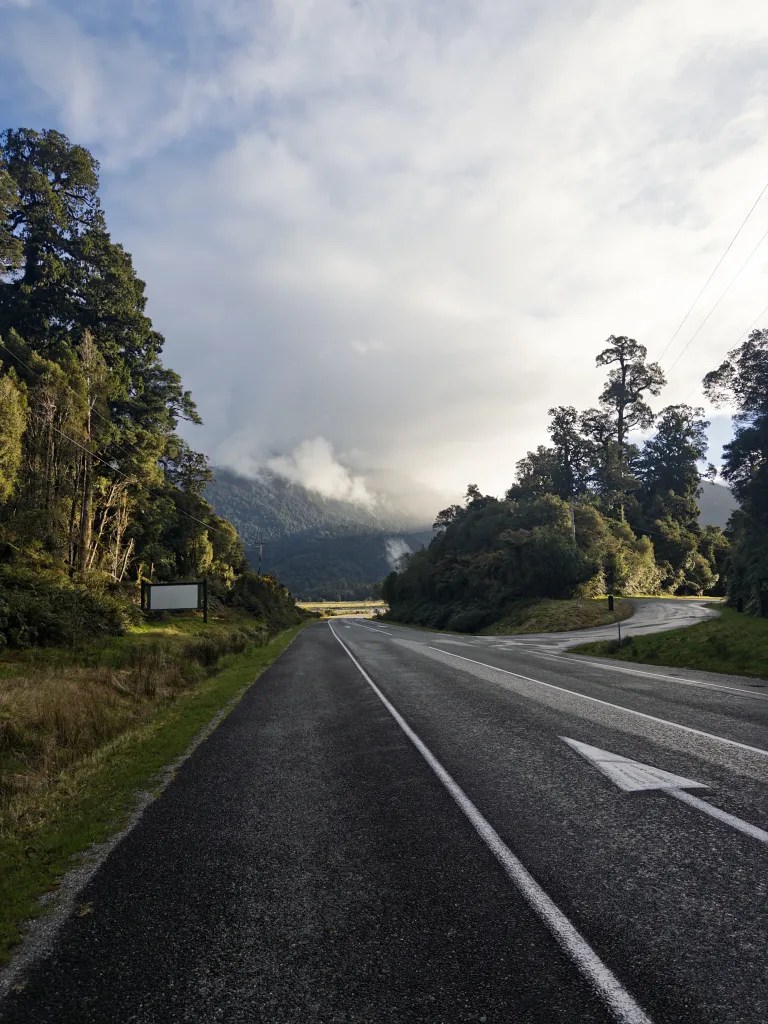
The last four days have been lovely. We joined a convoy heading over Haast Pass on Friday. New Zealand is a country that is constantly working on its roads, and it makes sense because there aren’t very many of them and they are the arteries of this little island. The road over Haast Pass was having landslide issues, so we lined up at 8:30 in the morning and hunkered down for the 10 am convoy while the construction workers loitered and the tourists complained. The locals sat in their trucks stoically.
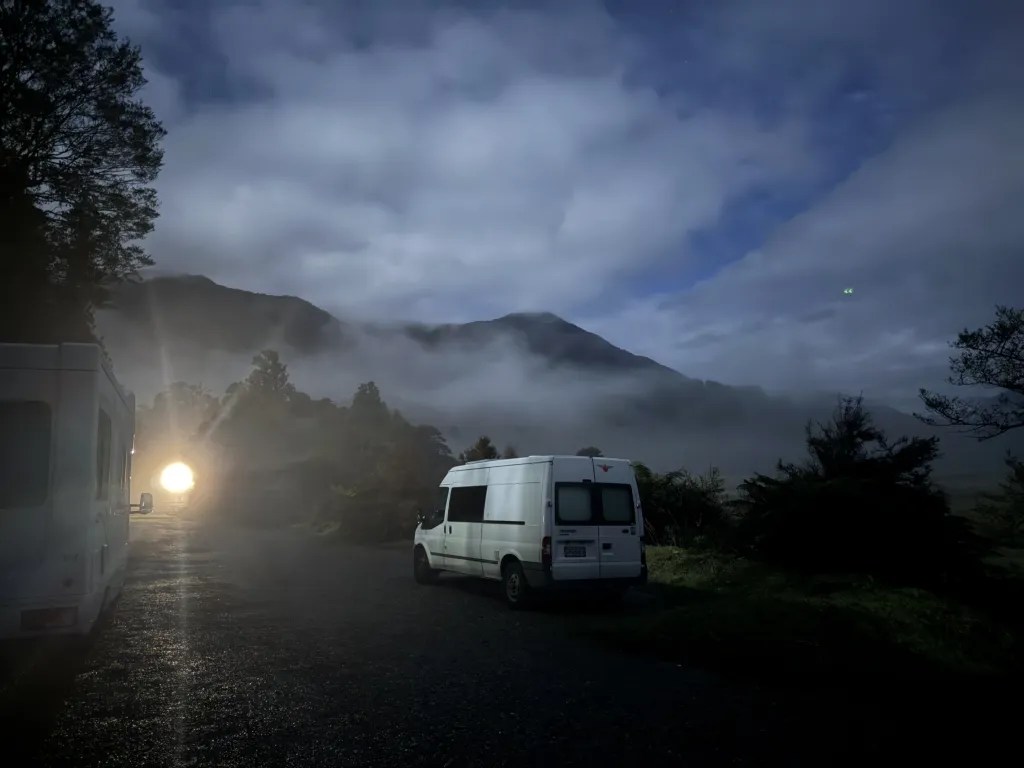
Haast is on the West coast of the island and it is wild over there. In New Zealand there are sheep and cows and there is tourism, and the west coast has comparatively small amounts of livestock and high amounts of helicopters. Every few miles we passed signs advertising flights to Fox Glacier or Franz Joseph Glacier or down south to the Milford Sound. Catie and I did not go on any flights. We stayed in a free campsite next to a run-down general store and battled mosquitoes as the sun went down over the cloud-draped hills.
We had built one extra day into our schedule and it’s good that we did, because on Saturday we realized that we were in a prime area to see penguins and whales. We spent our morning driving down the coast looking for dolphins – there’s a particularly endangered species that lives on the coast – but it was cold and windy and the dolphins must not have felt like playing in the surf. We stopped again in Haast. The owner of the general store there makes a mean sausage roll, and after dreaming about it all morning Catie and I spent a blissful ten minutes stuffing our faces with puff pastry and mincemeat and chicken chips in the back of our van. No time to set up the collapsible table. No need.
As the clock struck half past four we started our trek out to the beach where the Fiordland Penguins were supposed to live. Fiordland Penguins are those tiny ones with the little yellow spikes around their eyes, and September is mating season so it’s the best possible time to see them. They waddle up onto the beach at dusk, tired and full after a long day of fishing, and that was where we hoped to see them. We arrived at the beach by 5:15 with all of our jackets on.
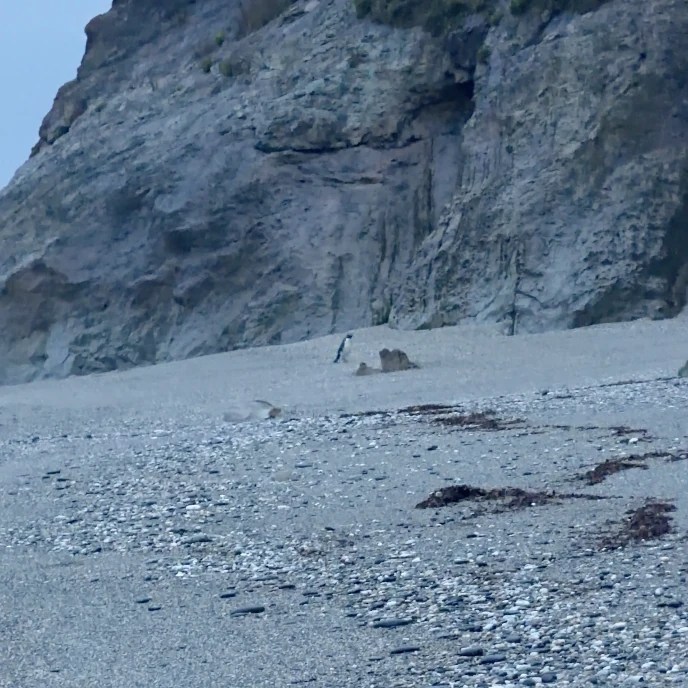
After less than ten minutes of walking Catie pointed down to the far end of the beach with wide eyes and excited little shouts. Sure enough, a little penguin was walking up the beach. We stopped in our tracks, maybe 50 yards away as it made its way hurriedly towards the brush. A few minutes later it returned, or its mate did, and slipped away into the water. We sat on our rock for an hour and a half with no more penguins. The two other couples at the beach left, but Catie and I were staying until sundown. We brought headlamps. The wind howled and the waves crashed and eventually another penguin appeared. We didn’t see it crawl out of the water, but rather when we looked to our right there was nothing and then the next time we turned our heads it was standing there, shaking the water off its little yellow eye-feathers and looking around. You get the sense these little guys know exactly how it feels to kick your shoes off after a long day of work.
A few minutes later one final penguin wandered homeward. Catie and I were feeling braver by then, so we ran half-crouched to a rock just 30 meters away. We got a slightly better view and slightly clearer videos as the little penguin commuted home, then we waited until it was too dark to possibly see any penguins at all, flicked on our headlamps, and trekked the 45 minutes back to the van.
It’s tough to communicate how euphoric it felt to wait for those penguins as we sat on that rock in the freezing cold huddled together for warmth. Our society is flattening. Rich and poor alike use the same cellphones and look at the same websites with the same number of ads. We have democratized instant gratification, and in the process we at the bottom and in the middle of the socioeconomic pecking order pick up a lot of the downsides of the French monarchy with few of the upsides (we’re all going insane and yet I don’t see myself getting fat on pheasant or buying new stockings every season anytime soon). It’s so easy to see crazy animals on our screens, to watch nature documentaries while we fall asleep, to book sightseeing tours that guarantee you’ll see nature’s most beautiful creations or your money back. You can see why the guys with the cameras do it, though, when you spend a couple hours alone on a frigid beach waiting for another glimpse of a tiny penguin. No wonder people camp for six months to see a snow leopard. That thing is out in the world! It lives here with us! I’m sure the crystal clear video is nice, but it’s not the point. The point is getting to take it.

Sunday was sadder. New Zealand’s glaciers are not what they once were. We hiked 45 minutes out to see Fox Glacier and all we saw was rocks and a hint of ice way up the mountain. We drove past Franz Joseph Glacier and I’m sure the view of that one is still halfway decent, because parking there cost money. Helicopters whizzed overhead, no doubt carrying wealthier tourists in nicer gear. We are wrecking this planet. We stayed at a very beautiful campsite in a town called Greymouth and drank cheap beer and watched Rashomon.
Yesterday we drove to Picton. Picton is prettier in the daylight, and the drive there was lovely. We wound through little clusters of houses overlooking bays full of sailboats. One last surprise on the South Island.
BlueBridge Ferry, same day, 9:54 am
Thoughts on the South Island: The people are a queer bunch. They mostly keep to themselves, though to be fair our van basically says ‘WE ARE TOURISTS’ in big orange letters on the sides. Polite folks but not chatty, they play it close to the vest. We’ve seen some kids, some people in their 30’s, and a lot of older folks. Not a lot of work opportunities combined with high cost of living and small quiet towns results in a rather geriatric society. Even the foreigners working the resort towns are in their late 20’s/early 30’s. Australians, Canadians, not a lot of Americans. The folks in Christchurch (abbreviated to ‘Chch,’ which I love) seem bewildered by the people living outside the big cities. In fairness, the folks living outside the big cities do come across as a bit odd. The environment matters here, and everyone we spoke to was outdoorsy to some degree. They think about geology and geography and conservation because the stuff really effects to them. The locals are proud of their homes in a way I have never felt about Bellingham or Seattle or even Vashon.
The South Island is beautiful and environmentally varied. Fertile valleys full of fruit trees and vineyards, mountains descending into the sea, rolling hills and grassy beaches. It’s a beautiful place to drive, but if I ever come back it will be to hike. The tourism feels the same as tourism everywhere I’ve been so far. Just like my friends take advantage of their comparatively high income to live like kings in Bali and Thailand and the Dominican Republic, aging westerners drop big bucks on rented motorhomes and eco-resorts and flights and cruises. Catie and I will leave New Zealand hopefully having spent less than $4000 USD. It takes no stretch of the imagination to picture spending four times that on a trip of the same length.
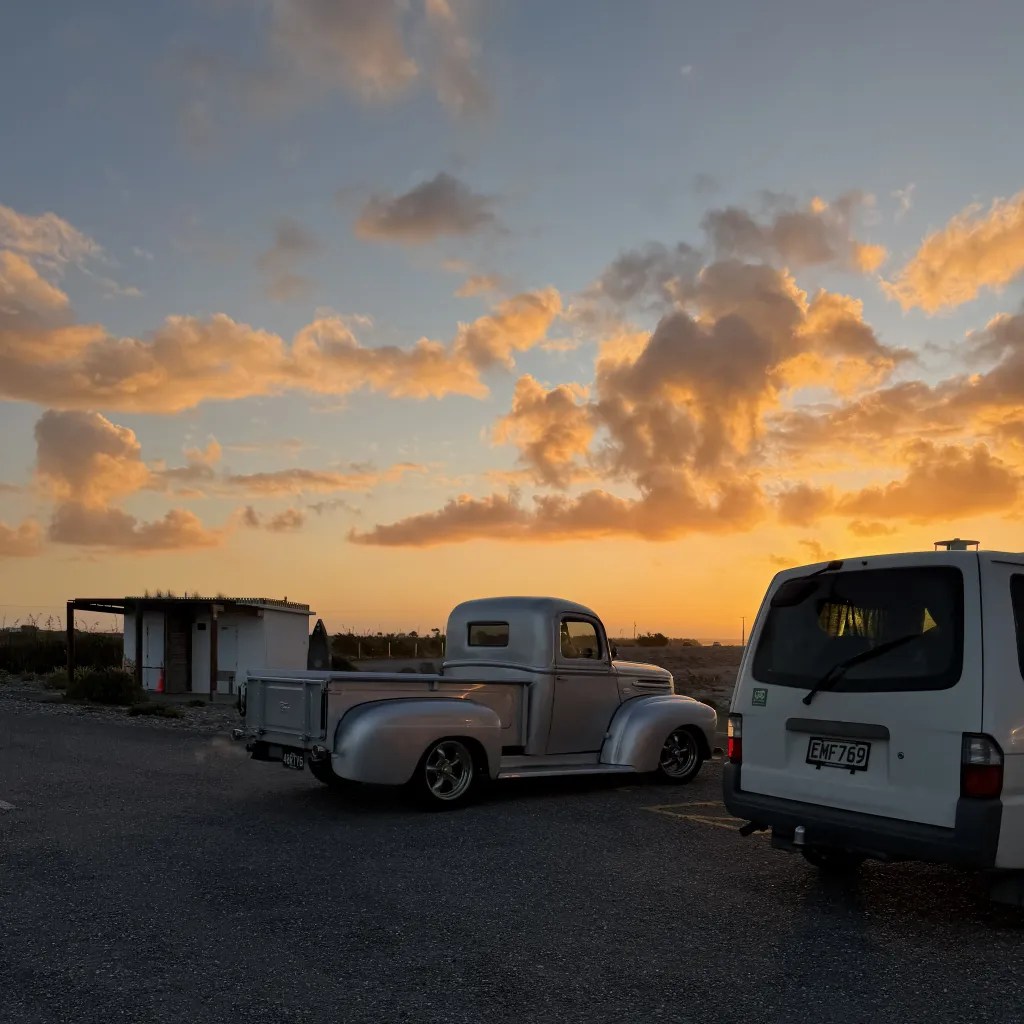
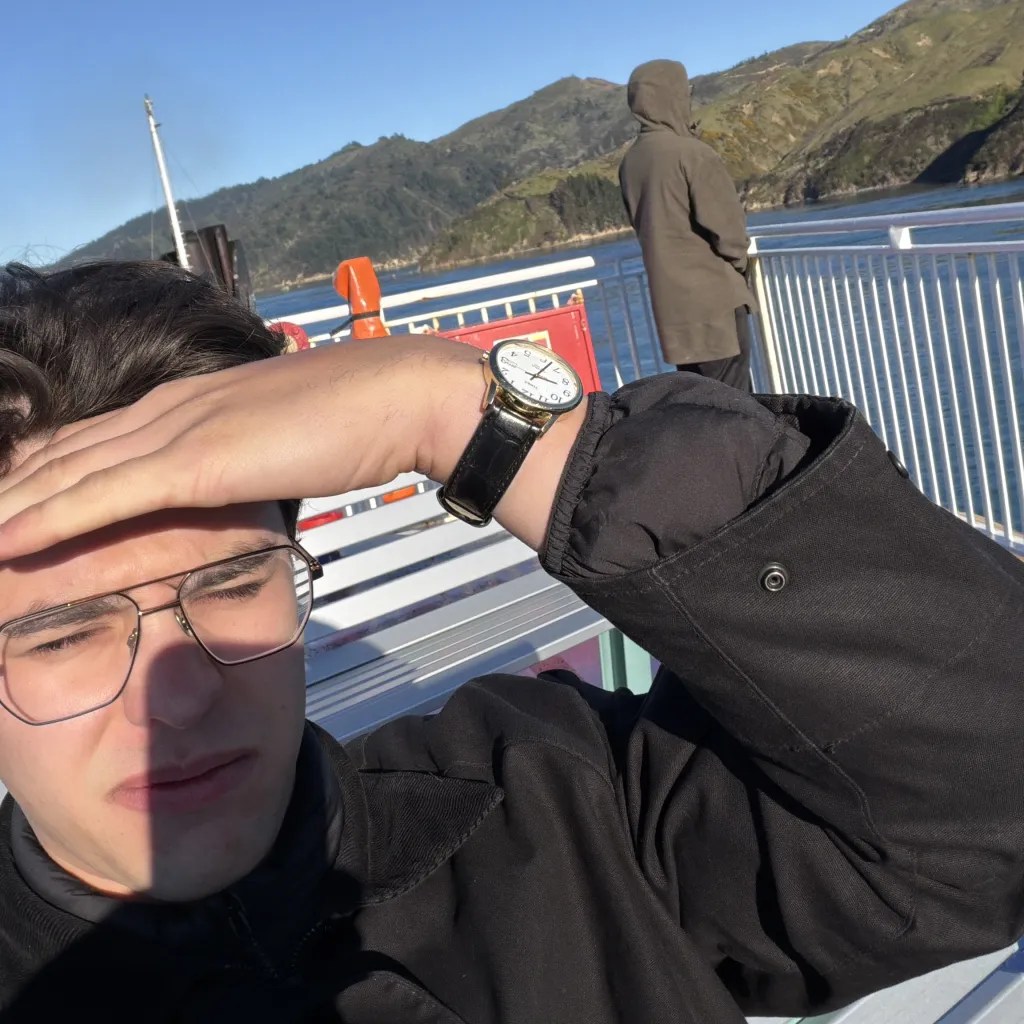
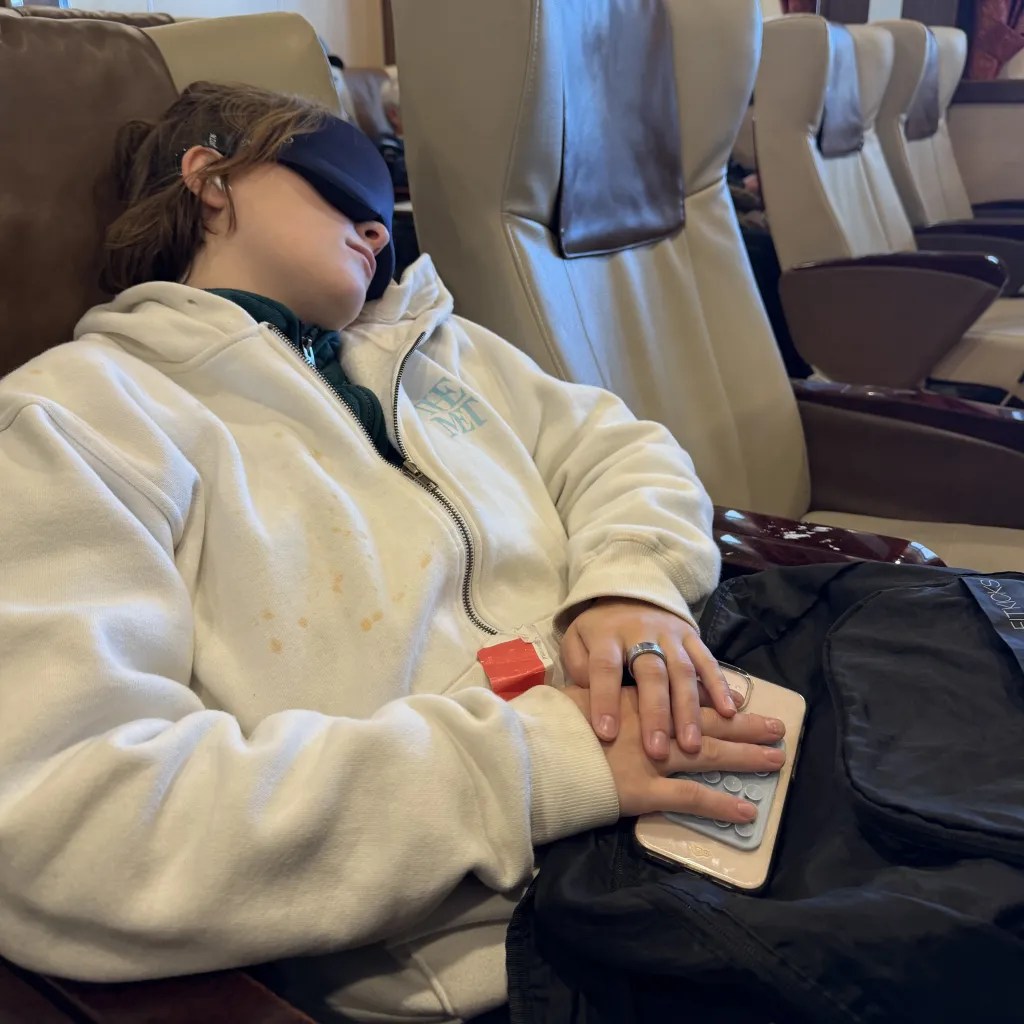
Gas has been our biggest expense; $500 USD in the past two weeks, but everything costs more over here. The towns are mostly small and relatively isolated, and the trucks that carry things over mountain passes and deep valleys can’t be cheap. The roads are beautiful and fun to drive, all winding two-lane jobs barely three meters across. The locals drive like maniacs, making turns at 120 kph that Catie and I don’t dare make at 80. We’re getting the hang of this driving thing, though, especially Catie. She does most of it. I sit in the passnger seat and take videos of the mountains.
We feel broke here, and lonely. When we flew out of SeaTac I still associated small talk with my job. Even without a paycheck, talking with strangers felt like labor. Three weeks later, we crave it. Tomorrow we visit my mum’s cousin and I am absolutely thrilled to talk with someone for longer than five minutes. I don’t miss work, per se, but I miss getting to be really good at something every day, and I miss making money. Since quitting I have been filled with creative energy, and it needs to go somewhere. I’m taking lots of videos, and some of them I’ll color grade and sound mix and post on Instagram as little moving photographs.
Catie and I are also starting a travel Instagram account. She’ll be the face and I’ll be the tripod and we’ll do our best to post a video a day. Right now we’re building backlog, shooting videos that I’ll edit over the next month and then we’ll do the same again during our three weeks backpacking in Australia and then once we get to Thailand we’ll start posting; one a day on Tiktok and Instagram, strategic and intentional and with the goal of making a little dough. Most of the travel videos I see are fun, but I don’t really need advice on which cave tour to do in Thailand. When I was in Bellingham I wanted to see people telling stories and figuring things out as they went along, and that’s what Catie and I are doing now. We haven’t seen any other young people in New Zealand and we hope that indicates an undersaturated market. If the account gets popular, which we hope it does, we’ll try to sell a PDF that collates all our travel tips in one place. By the time we launch it we’ll have some experience on the matter, and I’ll do most of the editing and hopefully hire our old roommate Owen to typeset it and make it look pretty, so I am confident it will be worth the price tag.
Three weeks in and I’m already stressed about running out of money. So it goes.
Time to head back down to the van. Wellington awaits!
Rotorua, New Zealand, October 2nd, 10:22 pm
The North Island is full of people! O, but it is full of challenges too! Thank goodness, because if Catie and I had to spend any more time only speaking with each other we might have both gone nuts. In Wellington we camped in a lovely parking lot in Evan’s Bay, walked into town, and enjoyed a wonderful day surrounded by people. ‘The sun was out for the first time in ages,’ the locals told us, and the city was alive. We saw the hot new movie Hope at an indie movie theater with soft red couch-style seats. I’ve been missing movie theaters. It was about a town on the North Korean border that gets attacked by monsters. It was a fun time. We went to a few cocktail bars and had a few genuinely good drinks. A bartender named Ross spent some time chatting with us and we got the sense that what little cocktail culture there was in New Zealand died of COVID sometime in 2020. Ross said that the liquor taxes are incredibly restrictive and that the culture is dying. Those guys were pouring an ounce of Buff Trace into a cup of sweet tea for every second customer who walked in and if I worked in this country for long I’d probably want to slit my wrists in a bathtub full of Campari.
Wellington is cool, though. You can feel the city’s artistic spirit, the rough edges, the rebel streak. The first bar we went to was in a basement with American signs and decorations. The second was upstairs and down the block, big French-style balcony with clear ash trays on the tables. I had a martini and smoked a cigarette, and Catie didn’t even pull a face. A cigarette is a beautiful thing if you only have one from time to time. I imagine that when the aftertaste stops being nauseating the trouble starts. For me, though, I just felt too drunk and tingly all over. The moment passed and we rode a bus back to our parking lot.
The next morning a man told us that we were double parked. Nice guy, mid 40’s and wearing a drug rug and pants that had elastic cuffs at the bottom. Super gay. He said his name was Scotty and he lived in a camper van and Catie and I reckon he was a bit lonely because he talked to us for an hour, easy. After warning us that we were double booked Scotty asked where we were going and, upon realizing that we didn’t know, he pulled out his map book and got to work plotting us a course to see all the best bits of the country in the five days we had left. He said we should go to Napier—
“The art deco capital of the world,” he said, and then on to Taupo, get out of Taupo ASAP, and see the Crates of the Moon. “Some people have told me they’re more impressive than Yellowstone,” he said. He told us we could skip Castle Point, a sleepy town 90 minutes outside of Masterton, and told us not to even bother with Rotorua. He told us about at least two of his exes and his time renting vans to tourists and so on and so forth until eventually we left without properly packing up or making lunch because we had a hunch the talking may not subside for quite some time.
My mum’s cousin lives in Masterton, 90 minutes from Wellington on a road that has more curves than many on the South Island. We made a pit stop 20 minutes in to get water from a natural spring in a town I can’t remember the name of. There were lots of us humans there, all waiting our turns at this big stone pillar with three spigots on three sides. Some people brought lots of little bottles, others brought a few big ones, a mother brought her four daughters, the eldest three all carrying plastic jugs. It was oddly compelling. We were like giraffes.
Masterton is a funny town. My mum’s cousin’s husband said that there’s a real wealth divide, poor folks crammed together while a few wealthy families hoard land on the periphery. My mum’s cousin seemed to be doing alright, though. She’s got a beautiful house and seemingly a very active life. Her husband is charming, with a wonderful laugh, and her daughter is shy but not as shy as she seems. Catie and I realized that we were the mysterious older people I remembered my mum hosting in my youth, big hulking 20-somethings with complicated blood relations to myself and a serious desire to impress. Catie and I babbled nonstop, a combination of our relative lack of outside interaction for the past two weeks and our desire to be good guests. Our hosts were incredible, and I’m almost blushing as I reflect on their generosity. They took us out for dinner at the local pub, bought us beers and just about every kiwi-made crisp and lolly on the shelf, got a bottle of wine for that evening, and then the next day took us out for breakfast and lunch. I am so used to playing the host that it felt a bit odd for the roles to be reversed, but at the same time I felt like royalty. We slept in real beds inside of a house that doesn’t go 60 miles per hour and in the morning I showered without having to go outside.
After a very fancy breakfast at the golf club our hosts drove us out to Castle Point and we had our first inkling that Scotty from the Wellington car park might not be the most reliable travel guide, because the place was stunning. A tall light house sat at the top of a hill as the wind blew us all around. We climbed up and down the rocks, walked along the beach, and enjoyed fish and chips at the local chipper. It was a spectacular morning, and my mum’s cousin’s husband was hell bent on feeding us as much as possible. We got the sense that his family takes hosting seriously, and I hope we were good enough guests to live up to his efforts. I’m not using everyone’s names because I do plan on sharing this stuff publicly, even if no one reads it. I’m not too worried about internet perverts trying to track down a guy named Ross based off of a vague description, but I would never want to get my family members in any kind of trouble. I guess I could take the Kerouac approach, but nobody wants to risk the possibility of irritating nerds from the future reading and rereading your stuff mostly to figure out who’s Alan Ginsberg and who’s Neal Cassady at a house party that happened 50 years ago.
We left immediately when we returned to Masterton. Everyone was getting sleepy and I was no exception, so I knew that making it to the next campsite before we crashed would be essential. We said our goodbyes to family and they pressed $200 in crisp New Zealand bills into my palm. Every bone in my body wanted to politely decline such generosity, but at the same time I was overwhelmed with gratitude. It’s frustrating to me… how impossible it is to properly convey how thankful I feel towards the people who show me kindness. When their little ones are old enough to see the world they can send them to us, and I’ll have a few starched Benjamins at the ready. We rolled into the last spot at a big campsite filled with locals just outside Napier and had a few beers and a chat with a Dutch couple who had moved to Auckland nine months ago with their dog. They were having a great time and so were we. I watched the Thomas Crown Affair on my laptop and the sky filled with stars.
This morning we woke up early and by 8:20 we were parking outside an auto glass specialist on the outskirts of Napier, the Art Deco capital of the world. We reckon a Kea took a chunk out of our windshield in the Milford Sound a week ago, and when we contacted the van rental place about it they told us that we could get it fixed ourselves and send them the receipt or that they could fix it for $90. We were ready to pay half of that and to kill a few hours in a cool town while the epoxy hardened, but instead a fellow in a black hoodie attacked our windshield with a dremel, frowned and fretted for about 20 minutes, and then came into the front office where we sat waiting and said,
“It went bad. The epoxy didn’t fill all the way and it looks ugly, but that’s just the luck of the draw. Hopefully it doesn’t crack.” The cheery woman at the front desk charged us $80 and told us we could drive right away. When we got to the van we saw that it really did look much worse, but the van rental people added the receipt to our file, so hopefully we aren’t charged an arm and a leg when we give it back.
Napier did nothing to raise our spirits. The Art Deco capital of the world fucking sucks. As far as I can tell it won its title not due to some architectural revolution after an earthquake in the 1930s, but because half the street signs are in that irritating art deco google font and a few of the one-story storefronts downtown have geometric cutouts in their whitewashed facades. No elaborate metalwork, no stepped skyscrapers. Catie felt convinced that the Portuguese coffee shop with half a dozen old people sitting out front would be good, and we got scammed for breakfast.
We were feeling a little skeptical of our friend Scotty after he had been wrong about Castle Point (worth the visit, absolutely lovely) and Napier (bad vibes, disappointing capital), but I thought he must have been onto something with this Craters of the Moon place. Mind you, I have googled almost nothing besides cocktail bars on this trip. I derive immense joy from keeping my expectations low and stumbling around, so all I knew about Craters of the Moon was that it was a place you could go that
“Some people said was better than Yellowstone.” I had no clue what that could possibly mean, but I spotted an impressive seeming jet of steam through the treeline on the drive up and I figured it had to be worth the $15 admission fee each of us paid.
I was wrong.
Craters of the Moon is two kilometers of wooden walkways around some steaming holes in the ground. The whole place is covered in thorny red bushes and smells like farts and half the signs have little astronauts on them, and I can’t imagine that anyone would ever find Craters of the Moon ‘better than Yellowstone’ unless they were smoking crack at Craters of the Moon and going through withdrawals at Yellowstone, or maybe Scotty meant ‘better (at making you feel angry and ripped off) than Yellowstone,’ but those are my only ideas.
Catie and I stomped around feeling thoroughly disappointed for a good half hour. The steam coming out of the ground is impressive on some level: it’s a genuine geothermal phenomenon and I’m sure it’s very interesting to study, but the corny theming and the cost of admission left us in a foul mood. Catie made me set a five minute timer when we got to the van. I spent my allotted time lamenting our shitty day, while Catie, intent on improving it, tracked down a hot spring only frequented by locals.
Unfortunately the hot spring was more of a hot pool at the base of a three foot waterfall, it was a beautiful Friday afternoon, and all the schools were out on Holiday. Catie and I sat on a bench in the sun while all the local children played in the tepid puddle.
We are indomitable, though, and we pressed on to another spot Catie had been dreaming of visiting since we booked our tickets to New Zealand. Kerosene Creek is a sulfurous river that sits somewhere around the temperature of a 30-minute-old bath, and after walking down a long gravel road because the potholes were the equivalent size and frequency of craters on the moon, Catie and I finally got to experience something free and good and warm. We basked in the smelly water beneath the signs warning us not to submerge our heads due to the presence of brain eating amoebas and beside the teenage boys who were taking turns submerging their heads in the waterfall on one side of the natural pool. A group of tourists arrived without swimsuits and took pictures of all the girls in bikinis. We walked back to the van.
Tired and emotionally battered after our day of sabotage-via-misinformation, we decided to abandon the path dear old Scotty had laid out for us. I can forgive a phony architectural capital and a bad call about a beach town, but Craters of the Moon was a bridge too far. I fear I’ll never be able to communicate how angry that place made me feel, and it may take years of therapy to unpack all the baggage I’ve accumulated on this wretched day. I’m still seething as I write these words. Tomorrow we’re going up to the Coromandel Peninsula, goddammit, because everyone says it’s fucking stunning. The day after that we’re driving North of Auckland. Same reason. That meant going East instead of West, though, and there was only one free campsite within half an hour of us and it was in the heart of Rotorua and in our hearts we knew it would be full.
We rolled through town at 7:00 pm and Rotorua looked alive, baby. We were dead, and all we wanted was a place to park. For such a touristy town, though, even Rotorua’s paid options were surprisingly scarce. Catie vetoed the first campsite for being too sketchy and I didn’t disagree. The second one was completely full, and so finally we ended up checking in to a third and final campsite five minutes before check-ins closed. I have never been so excited to spend $60. We had top ramen and potato chips for dinner, soaked in a hot tub, and showered. It was luxurious.
It’s 11:45 now and I’m finally simmering down. I’m so calm now that I forgot to even mention that our passenger side mirror flew off on the highway, that I had to jog along the road looking for the damn thing while cars screamed past me. It was a long day, and I feel wrecked, pooped, wrung out. Catie and I kept using this motivational line on each other,
“There’s still time for today to be our best day in New Zealand,” and it felt possible at 3:00, improbable by 5:00, and downright unrealistic by 7:00. I guess some days ‘best’ isn’t really on the table and you just gotta settle for ‘done’. Anyhow, it sure as shit beats working.
Te Kauwhata, New Zealand, Sunday October 4th, 9:59 pm
I have been lying about my nationality. The fact is Americans have a bad rep overseas – we’re loud and self centered and we frequently suffer from a failure of imagination. It is inconceivable to most Americans that we are not the center of the world and so when we meet other people we assume that they simply must dream of being American themselves, and I’m not even sure it’s such a bad habit of ours because many of us would like to welcome them with open arms should they decide to migrate to our shores. Anyhow, it makes traveling abroad interesting, and Catie and I are learning not to say which state we are from and not to apologize for our president. The former no one cares about because Canadians don’t say they’re from British Columbia and Chinese don’t say they’re from Xi’an, and the latter garners pained smiles because the truth is petrol isn’t $3.50 NZD per gallon here because of Labor or National.
I have been neatly sidestepping the problem while here by traveling on my Canadian passport. Everyone loves Canadians. A couple times now I’ve almost been caught though – the receptionist at the Milford Sound Lodge was from Vancouver Island – and today the lovely woman scanning my groceries had a few follow-up questions about life in Canada that I could not answer. I got lucky and she wanted to talk more than she wanted to listen, but gosh what a close miss.
Yesterday we had a lovely time driving up the Coromandel Peninsula. The Peninsula sits on the East coast of the island just below and to the right of Auckland, and there are just two roads into and out of it. We drove along a narrow road with the ocean on one side and steep hills on the other, big trucks with boats on trailers flying past us and old men and small children with long fishing rods perched on the beach to our left. At some point we lost the little plastic bit that covered the locking mechanism on our drivers side door, so when we stopped in the town of Coromandel for lunch I fired off an email to the rental company. I feel they gave us a van that was falling apart because we did not select one of their pricy insurance packages, and I worry they’ll try to gouge us for wear and tear when we give it back in two days. Everything in me wants to present all macho and no-nonsense when we give the van back, but I have a suspicion that the best way to behave will be with overwhelming courtesy, because that’s usually the case. I will politely insist we be present for the vehicles inspection. I will courteously point out each piece of damage, and the reasons why it was not our fault, and if they try to saddle us with excessive charges I will stand my ground like the trees on the beaches of the Coromandel Peninsula weathering some hoary storm.
For lunch we had fish and a battered sausage and ice cream. The battered sausage was nothing to write home about, but I had never had one before so I was excited. The fish was to die for, as all of the fish in New Zealand has been (it seems ‘fresh’ means something different here than in the states). We drove East. By 6:30 we had hit a beach on top of a hot water spring. Catie bought a hoodie that read ‘Hotties Beach’ with a lady surfing in a bikini on the back and we walked out to the throng of parents and children digging in the sand to access the hot water underneath. We had no shovels and I held my white leather sneakers in my hands, but we still stood in the surf and felt the water between our toes shift from hot to cold to hot as the tide came in and went out.
It was nice. Hot Water Beach was free to visit, and so we felt less like cattle herded through a maze of fencing and more like human beings united in experiencing something special. We left satisfied.
Cathedral Cove was next, and the Kiwis had learned from their mistakes with Hot Water Beach. There’s a park-and-ride 25 minutes walk from the access point to Cathedral Cove and no parking at any point in between. Some enterprising locals have set up DIY parking lots in their driveways, it’s so bad. We drove up to the drop-off point, had a look at the rocks in the water, and left town. Even if I had the money, I think I’m morally opposed to that kind of thing. I’m a human being. I will not be herded.
We ended up in a parking lot at the far end of a very wealthy neighborhood. No shops, just expensive houses and as few streetlamps as possible. The spotless sidewalks were empty by sundown, but Catie and I went for a walk. Just us and the birds and the half-empty houses.
Today we did less. We visited Hamilton, the last big city in New Zealand that we were missing. I told Catie with confidence that our van would fit in the parking garage with the big “1.92 METER MAX CLEARANCE” signs, then my heart shot out of my chest when we heard a resounding crack on the ramp up to the second story. The parking garage hadn’t accounted for clearance on the diagonal, and the air vent on top of our van was absolutely mangled.
I’ll probably have to pay for that regardless of the tone I take with the dealership representative, though I’ve emailed the parking garage in a vain attempt to get their insurance to pay for the damage. You miss 100% of the shots you don’t take, as Gretsky says.
Hamilton was alright. Sleepy on a Sunday, mostly small one-story buildings of a similar make-up as the rest of the country. We got coffee at Scott’s Epicurean, a shop that stuck out to me primarily for the invocation of a 2,000 year old philosophy. We had skipped breakfast, and after the shock of breaking part of our rental van Catie needed comforting, so we spent a whopping $78 NZD on an all-you-can-eat Korean buffet. It was delightful.
There were eight kinds of chicken wings, japchae, kimchi, mac and cheese, mandu, and a cornucopia of raw meats. We cooked skirt steak and pork belly and spicy chicken on a charcoal grill. I must have had at least ten chicken wings and four servings of japchae and enough meat to empty a slaughterhouse, and by the time we left our stomachs were so full that we had to spend half an hour laying in the van digesting like snakes. We left the parking garage, cracking the exhaust vent once more, and said goodbye and good riddance to Hamilton.
Now we’re in Te Kauwhata and it’s a cute little town. We rolled in rather early and mostly spent the afternoon lazing around. I bought some wine and some cleaning supplies so we can make the van look nice before we return it, and we watched Porco Rosso on Catie’s iPad. What a movie! I’m so impressed by Mr. Miyazaki. I am appreciating that compelling movies are dense. Thematically, visually, and narratively. Porco Rosso succeeds on all fronts. The decision to make the main character a pig is a perfect example: it allows us to sympathize with such a competent character, it subverts the metatextual ideas of how such an animal might behave, it provides an opportunity for character development that is shown visually rather than just told, and it makes a clever pun for bonus points. It is clear that Mr. Miyazaki has a genuine gift for assembling cinematic images, and I hope that one day I can make work that is a fraction as beautiful as his.
Catie snores beside me now. She drank nearly as much wine as I did, and she’s only 2/3s my size. I miss marijuana. I miss drinking and smoking myself into oblivion, and I recognize that it’s not the healthiest thing to miss, but God I am stuck in the soup of it all! There is no retreat from life. I feel like I am in middle school. All the same I will be okay. Few of my role models died of old age, and I don’t want to go out like them. We face our discomforts head-on until we can’t anymore, and at that point we might as well be dead. Not like we’re getting any more meat off the bone of life anyhow.
Tomorrow we clean the van. We launder the pillow cases, scrub the floors, wash the dishes. At 3:00 we’ll visit a local distillery. They’re aging single malt whiskies in native wood barrels and I’m very excited to see their operation. Usually they only give tours on Saturdays, but I sent them an email and the benefit of asking people for things is that sometimes they say yes. I am very excited.
Hamiltons Gap, New Zealand, Monday, October 5th, 8:28 pm
Our last night in the van! Some remarks on van life:
To be done sustainably I would need to be able to cook food without being exposed to the elements. The elements are a problem in general, actually. The wind shakes the van and the rain makes your front stoop into a mud puddle and when it’s sunny out your neighbors The Mosquitoes invite themselves over for a potluck. I’ve been ‘in touch’ with nature in a way I’ve never experienced before. Catie and I stop driving before the sun sets. The morning light greets us through the cracks in our gray curtains and every morning for the past three weeks we have opened our eyes in a new place.
In addition to being the most annoying par of van life, the connection to the outdoors is the best part too. If I were to live like this full time I would want a van that is a little taller and a little longer and a job I could do remotely. I would install a shower and a toilet within the vehicle and I would work from home and look out the window at the beach or the desert or the mountains with nary a concern in the world.
The worst part about van life long term might be the other people who do it. There’s nothing wrong with them, but New Zealand is not a country where we’ve been able to pull off on the side of the road and go to sleep wherever we please. We’ve shared every parking lot with at least a few other vans, and it gets tiresome to live such a lonely life whilst never having a neighbor living more than thirty feet away.
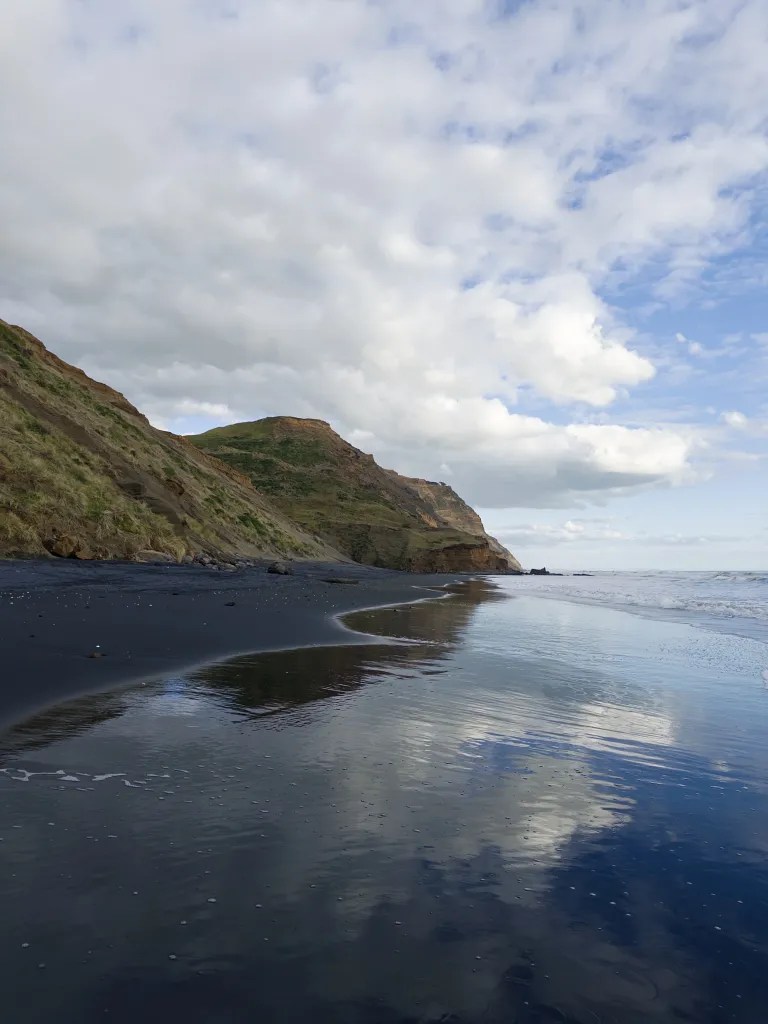
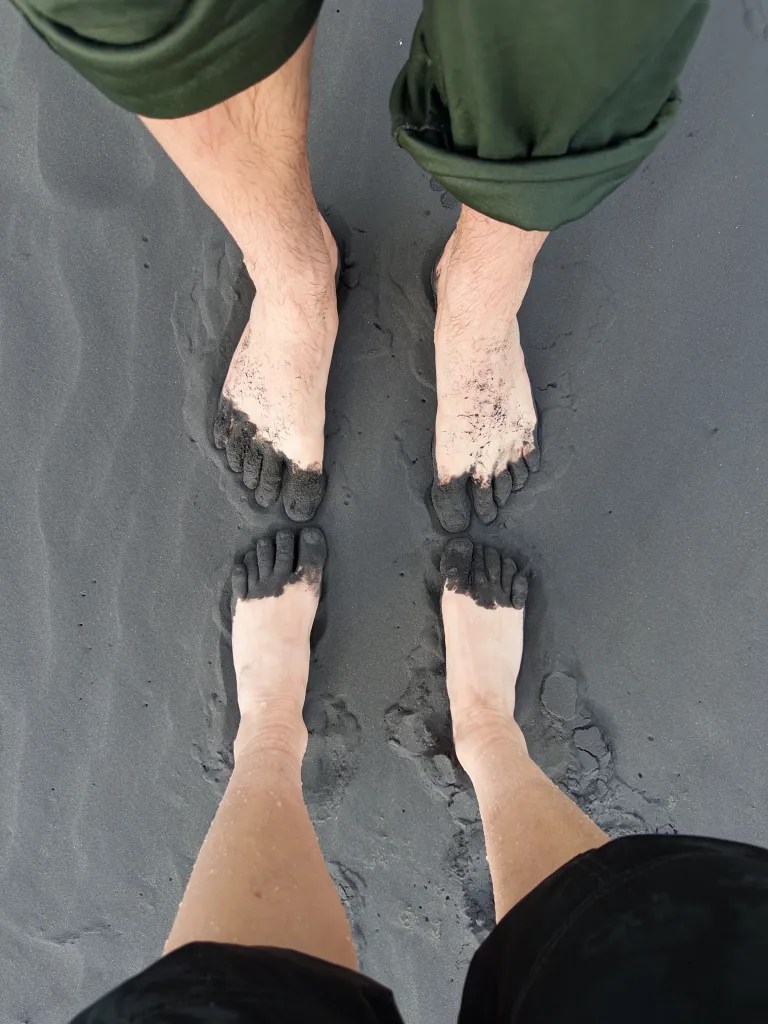
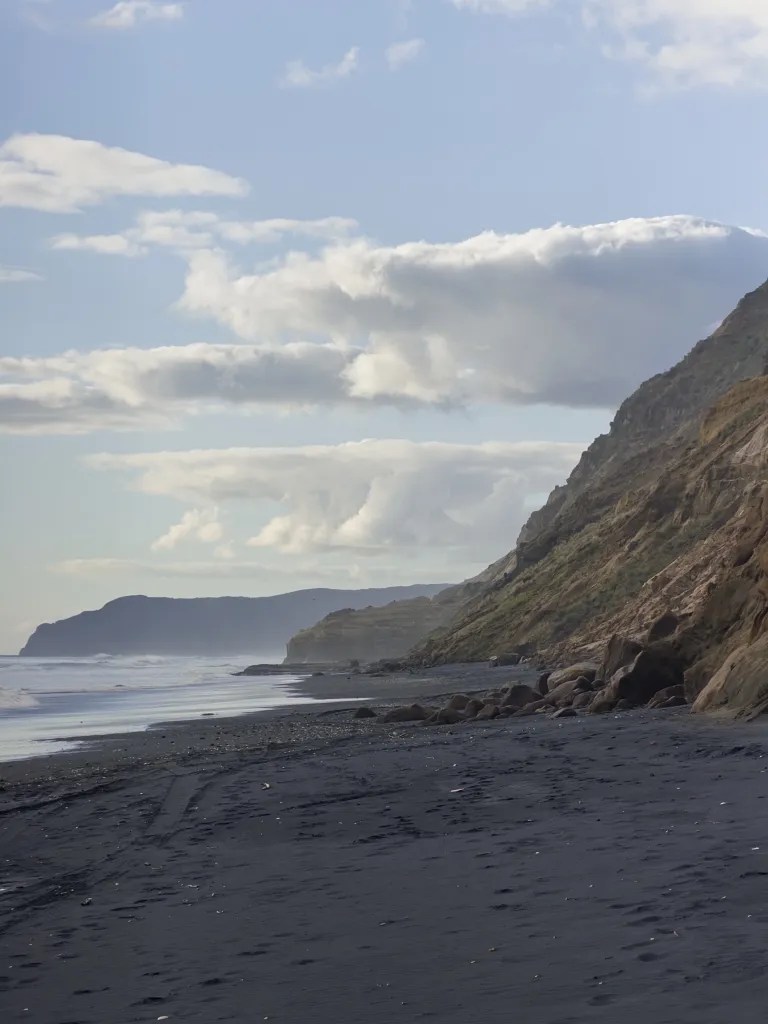
I don’t think van life is for me. Catie and I have spent too long in this tin can Toyota. I respect the Kiwis who live this way full-time. The laws allowing it are so new, and so the van-lifers are trailblazers and misfits and cowboys. There are two campers permanently parked at tonight’s spot. They have little gardens and deck chairs and one of them even has wifi. Their backyard is red sand dunes and a beach of sparkling black sand with good fishing and great sunsets. It’s a nicer piece of land than I’ll ever live on.
Tomorrow we’ll talk to one of the gentlemen who lives here. He’ll be in his 70’s, lifting weights in a leather jacket while one of his cats sits beside him. The police will come to arrest him later that afternoon, he’ll tell us. He’ll say that he has a lawyer, that it’s “an unjustuce and a violation of muh cuvul luburties.” He’ll be correct, in my opinion.
Today was a good way to end things. Catie woke up with a pounding hangover and a stuffy nose. It seems like the sulfites in last night’s Syrah triggered her alcohol allergy something awful. She mostly slept until we rolled out at 11. We got gas and visited a laundromat in Pukekohe, a little town that didn’t seem too remarkable based on the bits we saw. We washed the pillowcases in the van and scrubbed everything out while they dried. Goal is to leave the thing better than we got it, even if it insists on falling apart on us. It’ll be interesting to go through the inspection with the rental employee tomorrow. There’s so much that’s broken and I’m going to try to convince him that none of it is our fault despite it all breaking while the van was in our care, and I reckon I’ve got about a 50/50 chance of success. Makes me anxious just thinking about it. New Zealand has already cost an arm and a leg, so I’m really hoping the rental company won’t take one of my nuts too.
We visited the distillery in Pukeno. Gareth showed us the copper stills and the bulk barley and the cooperage and the aging rooms. It was our first time in a distillery and I reckon we asked the right kind of questions. I fear I still come across as eager to impress because I really do desperately want everyone to think I’m smart and cool and knowledgeable. Gotta let go of that one. I’m hoping our traveling will help, will make me less neurotic and less desperate to please. I’d like to come home with a sort of quiet confidence, an erect carriage and a glint in my eye that says ‘this guy’s seen some shit. This guy is the real deal,’ but as I write it out I realize that maybe this is one of those perfidious little mental conundrums where the only way to accomplish the goal is to relinquish all desire to succeed. We don’t become happier by intentionally doing things that we think will make us happier and all that.
Catie is worried she has a cold now. I’ve been sniffling for a few days and I think it’s been allergies, but she’s pretty sure I’m harboring some gnarly rhinovirus. I really hope she’s wrong. We were just sick and I’m sick of it. Two full days in New Zealand to go, so we’ll just have to kick back and see what happens. Worst case scenario: two days sick as hell in my mum’s friend Patrick’s apartment, pounding nyquil and dayquil and benadryl in the vain hope that we’ll be fighting fit in time for our China Air flight from Auckland to Brisbane. Best case scenario? Cocktails, morning runs, and that new Alejandro Inarritu movie Digger. The nerds on the internet are using all my favorite buzz words when they talk about it. For now though, sleep. Catie has given me a Benadryl, and even though I don’t usually dabble in the hard stuff I’ve decided to indulge. I’ll sleep like a baby and float like a butterfly and sting like a bee, and in the morning I’ll wake up anxious and eager to avoid paying out the $3500 bond on Catie’s credit card for damage to the vehicle and I’ll remember how calm, cool, and collected the titular character of Porco Rosso is, even when he’s threatened by pirates or elbow deep in debt. Be like the pig, Isaac, I’ll say to myself. Be like the pig.
Mission Bay, Auckland New Zealand, Thursday October 8th, 8:21 am
Last day in New Zealand! In half an hour Catie and I will go down to the beach for a long black and a sausage roll, we’ll clean the apartment, make lunch, pack and repack our bags, then at 3:30 we’re out of here for our 8:10 flight to Australia. We’re staying in one of my mum’s friend’s apartments and it is feeling straight up luxurious compared to the van. He lives in a one of the ritzier neighborhoods just a 20 minute bus ride from downtown, and he has a big kitchen island and a glass-walled balcony looking out over the neighborhood. I hope the beers I’m leaving in the fridge for him accurately convey my gratitude.
I didn’t end up needing to worry about the van drop off at all. I try not to make assumptions because I’m usually terribly wrong, and in none of my half-dream fantasies did I even come close to predicting what the van drop off would really be like. The Auckland location was far nicer than the one in Christchurch. They had a few of their shiniest models parked up in a big warehouse with a fancy backdrop and all the bells and whistles for wealthy prospective customers. A rather short Indian man greeted us, but his kindness changed to concern as we handed him the bits of the broken mirror and explained that it had come flying off somewhere on the highway a few days earlier. He was a professional and escalated to his boss, and while I was prepared to wheedle and whine and bust out my American legal posturing and all that, I was completely unprepared for a hulking Australian man to walk out into the lot, ask if we had broken his car, and then decide that every bit of damage was cosmetic and that we wouldn’t need to pay for any of it. He didn’t care about the mirror or the mug with the busted handle or plastic window lock or any of it. The other fellow emailed me our receipt and gave us a notecard with the number 4,747 written on it. That was how many kilometers we drove over the last three weeks – roughly 3,000 miles, or the whole width of the United States.
We rode the bus back to the apartment sitting two inches higher than usual because of all that weight having been lifted off our shoulders. I took a shower and then left again almost immediately to see the movie Digger. I knew I had to see it when the American critics panned it, the European critics loved it, and the little nerds on the internet said it was about the futility of art, climate change, and a world that is already over. To my surprise, the little nerds were bang on. The first twist had me totally unimpressed, but it sucked me back in in a way no movie ever has before. Digger is an onion; three layers of storytelling layered on top of each other like a bean dip made of satire and drama. It’s all over the place tonally, but simultaneously constructed with such precision that every ‘mistake’ in the execution of the film enhances the narrative. I am not sure I’ve ever seen anything like it, and I will be shocked if it recoups even 10% of its budget at the box office.
By the end of the film, when the three layers of narrative have been squashed together and Uncle Digger ‘does the thing that he does,’ as Kenny might say, tears welled in the corners of my jaded eyes. Art isn’t a weapon for social change, not like political protest and community organization and good old-fashioned firing squad. It has the effect of a pie dropped on the ground from six feet up or a laser pointer aimed at the moon, but that’s not exactly the end of the world because it’s not what art is for, anyways. The joy is in the act of creation, the collaboration with other human beings, and the sliver of opportunity to hold a mirror up to friends and strangers alike. Digger is about all of this, and I enjoyed it immensely. I do not think all of my friends and loved ones will enjoy it – in fact, I think very few of them will – but I do hope they all see it all the same.
I met Catie at a cocktail bar afterwards. Panacea is two rooms mostly filled with low couches and coffee tables and medicine cabinets full of rare liquor. There are high tables with desk lamps for two-tops and little curtained alcoves for you and all your friends. The walls are covered in vintage liquor boxes and the bricks are exposed and it’s all very tastefully done, which makes the juxtaposition with the hiphop blaring from hidden speakers and the menu full of seemingly AI-generated photos of astronauts in basketball shoes holding cocktail shakers even funnier. Panacea is a ‘bar without a bar’. Every drink is pre batched, and there must be at least forty of them and about half of them use techniques I’ve never heard of before. They make a Miami Vice with cream sherry as the base spirit and then clarify it through marshmallow. They use rennet (most commonly found in cheese making) and brewer’s enzymes to curdle milk punches without acid. They have tea infusions that rest for 30 days before being served and their own take on super juice that blends entire limes before clarifying them with pectinex to preserve mouthfeel and prevent food waste. It is an astonishing cocktail program.
Catie and I got to meet three of their four employees and they’re all very impressive gentlemen. Dany is the owner, as far as I can tell, and his jaunty pink beanie, drop crotch skinny jeans, and beautiful geometric tattoos go a long way in explaining the fascinating combination of aesthetics that make up Panacea’s visual language. Dany’s been around, from what I can tell, and it sounds like he comes up with a lot of the ideas that eventually become new drinks. PJ is their ringer, so to speak. He won the Jameson Black Barrel competition this year and it’s obvious why once you talk to him for a few minutes. He was incredibly humble, but I got the sense that once Dany has an idea, PJ goes to work developing new techniques that will make it possible to execute. The citrus stock and the rennet clarification are PJ inventions, and I’m blown away that these guys are operating such an insanely experimental operation in a country with such a low concentration of cocktail bars. Leon is their bright eyed and bushy tailed youngster. Once Dany had figured out that Catie and I were interested in cocktails he sent him over to answer as many questions as we could throw at him, and we had lots. Leon’s no slouch either – he made top five in the most recent 50 Best young bartender competition, and he had plenty of fascinating ideas and recommendations for us. Most of all I was impressed by their generosity and kindness. I’ve annoyed the hell out of a lot of bartenders with all my questions in the past, and it was thrilling to meet three guys who genuinely wanted to talk about the things they work so hard on. I’m not sure I like the performative humility that so many of the old guard I’ve met employ in order to seem cool. Shit, I spent a lot more money at Panacea than at most of the other guys’ bars.
We stumbled out of Panacea feelin’ pretty good, so we went back to Caretaker and got horribly drunk. We did shots of buff trace with the bar staff while they got absolutely slammed and I felt sad that no one put me to work. I really love bartending. We got Indian food at midnight and woke up severely hungover.
Yesterday we chilled. Catie does indeed have a cold, so she didn’t really leave the building. I went for a run and tweaked my knee, which was a bummer, but it was nice to see a bit of the neighborhood. There were about a million people down at the beach and it was lovely to see the kids playing in the fountain and teenagers laying around like seals and the parents all stood up like meerkats. I went back to Panacea, knocked out some of the stuff I hadn’t yet tried on their menu, and even got to try some of PJ’s feijoa eau de vie. Feijoa is a fruit from Brazil that grows just great here in New Zealand, and PJ uses a copper pot still to distill 170 kilos of the stuff down into about 8 liters of eau de vie. It was absolutely incredible. Feijoa is light and tropical tasting, with hints of lime, guava, and pineapple. It reminded me of a weak aroma baijiu, and I desperately want to try aging some in one of those manuka honey barrels the guys at Pokeno had.
I came back to the apartment and we made chicken soup for dinner. It was a lovely evening.